James Clerk Maxwell | Biography, Discoveries & Legacy
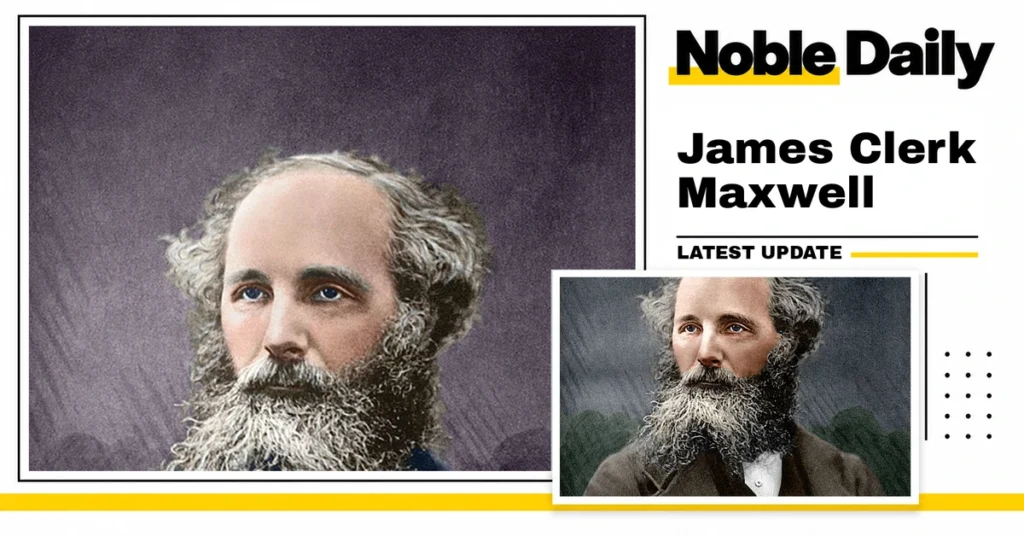
James Clerk Maxwell was a Scottish physicist and mathematician whose work united electricity, magnetism, and light in a single theory. Born in 1831, he also advanced color science, the study of gases, and research on Saturn’s rings. His ideas helped shape modern physics and later influenced scientists such as Albert Einstein.
Who Is James Clerk Maxwell?
James Clerk Maxwell was a Scottish mathematical physicist best known for explaining how electricity and magnetism work together and how they relate to light. His research also changed color science, gas theory, and astronomy, making him one of the key figures in the development of modern physics.
| Full name | James Clerk Maxwell |
| Born | June 13, 1831 |
| Birthplace | Edinburgh, Scotland |
| Died | November 5, 1879, in Cambridge, England |
| Age at death | 48 years old |
| Nationality | Scottish |
| Profession | Physicist, mathematician, and professor |
| Known for | Electromagnetic theory, Maxwell’s equations, kinetic theory of gases, and color research |
| Education | University of Edinburgh and University of Cambridge |
| Wife | Katherine Mary Dewar |
| Children | None |
| Major book | A Treatise on Electricity and Magnetism, published in 1873 |
| Burial | Parton, Dumfries and Galloway, Scotland |
| Net worth | No reliable historical estimate is documented |
Early Life and Family in Scotland
James Clerk Maxwell was born on June 13, 1831, in Edinburgh to John Clerk Maxwell and Frances Cay. His family later moved to Glenlair, their country estate in Kirkcudbrightshire, where he spent much of his childhood exploring how everyday things worked.
As a young child, Maxwell asked constant questions about doors, locks, streams, and other practical puzzles. His mother died when he was eight, a loss that changed his early family life. His father remained an important influence until his own death in 1856.
Maxwell’s curiosity was not limited to science. He enjoyed poetry, drawing, and making small mechanical models. At school, classmates sometimes misunderstood his unusual interests, but his strong ability in mathematics and writing became clear as he grew older.
What Was James Clerk Maxwell’s Education?
Maxwell studied at the Edinburgh Academy, the University of Edinburgh, and the University of Cambridge. He entered Edinburgh University at age 16, where he studied mathematics and natural philosophy, the term then used for physics.
In 1850, he moved to Cambridge, first attending Peterhouse and then Trinity College. He graduated in mathematics in 1854 and ranked as a Second Wrangler in the demanding mathematical examinations. He also shared the Smith’s Prize, an important award for mathematical achievement, and later became a Fellow of Trinity.
When he was only 14, Maxwell had already written a mathematical paper about oval curves. It was presented to the Royal Society of Edinburgh by a professor because Maxwell was considered too young to present it himself. The work showed the unusual range of his early mathematical thinking.
How Did Maxwell Build His Scientific Career?
Maxwell began his university teaching career in 1856 as Professor of Natural Philosophy at Marischal College in Aberdeen, Scotland. There, he studied the stability of Saturn’s rings and continued experiments on color and human vision.
In 1860, he became Professor of Natural Philosophy at King’s College London. These years were especially productive for his work on electromagnetic theory, color perception, and the behavior of gases. He left King’s in 1865 and returned to his family estate at Glenlair, where he had time to develop his major theories.
Cambridge appointed Maxwell its first Cavendish Professor of Physics in 1871. He helped plan and establish the Cavendish Laboratory, which formally opened in 1874. He also studied and edited the scientific papers of Henry Cavendish, publishing them in 1879.
What Are Maxwell’s Equations and Why Do They Matter?
Maxwell’s equations describe how electric and magnetic fields are created and how they affect one another. They brought together discoveries made by several scientists, including Michael Faraday, whose experiments and idea of lines of force helped Maxwell build a mathematical account of electromagnetism.
Maxwell developed this work across several papers and presented a fuller account in his 1873 book, A Treatise on Electricity and Magnetism. His original mathematical presentation was more extensive than the four compact equations commonly taught today. Later scientists, including Oliver Heaviside, helped recast the theory into the familiar modern form.
The equations explain major features of electricity, magnetism, and electromagnetic waves. They later became a foundation for technologies such as radio, radar, wireless communication, and modern electronics. Maxwell did not invent all of these devices, but his theory helped make their development possible.
How Did Maxwell Connect Electromagnetism With Light?
Maxwell showed that electromagnetic disturbances travel at a speed close to the measured speed of light. He concluded that light itself is an electromagnetic wave, linking two areas of physics that had often been studied separately.
This insight was one of his most important achievements because it changed how scientists understood light and energy. His work later influenced Albert Einstein, whose thinking about space, time, and physical laws developed in a world shaped by Maxwell’s theory. Einstein regarded Maxwell’s contribution as a major turning point in the history of physics.
What Did Maxwell Discover About Color and Photography?
Maxwell made major contributions to color theory and helped demonstrate how red, green, and blue light can combine to reproduce many colors. He studied how people perceive color and used mathematical experiments to compare mixtures of colored light.
In 1861, photographer Thomas Sutton worked with Maxwell on a famous color demonstration using a tartan ribbon. Sutton made three black-and-white photographs through red, green, and blue filters. When the images were projected together through matching filters, they recreated a colored image of the ribbon.
The achievement is often described as the first color photograph, but that label needs care.
Maxwell’s demonstration used three separate monochrome images rather than one color image like a modern photograph, and earlier color photographs of light spectra had been made.
Even with that distinction, the experiment became a landmark in the history of color photography and helped establish the principles behind later color imaging.
How Did Maxwell Explain Gas Molecules and Heat?
Maxwell helped explain heat by studying the motion and speed of molecules in a gas. His work on the kinetic theory of gases treated heat as the result of many tiny particles moving and colliding, rather than as a substance that simply flowed through an object.
He developed a statistical description of molecular speeds, now known as the Maxwell-Boltzmann distribution when considered alongside related work by Ludwig Boltzmann. The distribution describes how molecular speeds vary within a gas at a given temperature.
It became an important tool in statistical mechanics and helped connect the visible properties of gases with the motion of their molecules.
What Did Maxwell Learn About Saturn’s Rings?
Maxwell showed that Saturn’s rings could not remain stable if they were one solid, continuous structure. In his prize-winning study, he used mathematics to test different explanations for the rings and concluded that they must consist of many separate particles orbiting Saturn.
His essay won the Adams Prize in 1857 and was published in expanded form in 1859. Spacecraft observations much later supported his central conclusion. The work is a striking example of how mathematical reasoning can reveal the nature of a distant object even when direct observation is limited.
What Is Maxwell’s Demon?
Maxwell’s demon is a thought experiment that tests how scientists understand heat, probability, and the second law of thermodynamics. Maxwell imagined a tiny being that could observe gas molecules and let faster ones pass through a small opening in one direction while slower ones moved the other way.
The sorting process seemed as if it could create a temperature difference without using energy, which appeared to challenge the usual rule that disorder in an isolated system tends to increase. Maxwell did not claim that such a creature existed.
The idea helped scientists explore the statistical nature of thermodynamics and later debates about information and entropy.
Who Was James Clerk Maxwell’s Wife, and Did They Have Children?
James Clerk Maxwell married Katherine Mary Dewar on June 2, 1858, and they had no children. Katherine was the daughter of Daniel Dewar, who led Marischal College in Aberdeen, where Maxwell was a professor.
Katherine supported some of Maxwell’s scientific work, including observations connected with color vision and experiments on gases. Their partnership also included shared religious study and a close personal bond. Maxwell’s letters show that he valued her company and intellectual support.
What Role Did Religion Play in Maxwell’s Life?
Christian faith was an important part of Maxwell’s personal life, although his beliefs should not be reduced to a single label. His father was Presbyterian, and an Episcopal aunt also shaped his religious upbringing. As an adult, Maxwell continued to study the Bible and discuss faith in letters to Katherine.
He also supported church and community life near his Scottish home and became an elder in a local congregation in 1863. His religious views existed alongside his scientific work. He approached nature as something that could be studied through careful observation, mathematics, and experiment.
When Did James Clerk Maxwell Die, and Where Is He Buried?
Maxwell died in Cambridge, England, on November 5, 1879, at 48 years old. His death was caused by abdominal cancer. He had continued teaching for much of his final year, even as his health became worse.
He was buried at Parton in Dumfries and Galloway, Scotland, near the family estate. He is not buried at Westminster Abbey. His short life ended before many of the practical technologies shaped by his theories had fully developed, but his scientific influence continued to grow after his death.
What Awards and Honors Did Maxwell Receive?
Maxwell received recognition for both his mathematical work and his scientific discoveries. His key honors and career milestones included the following.
- The Adams Prize in 1857 for his mathematical study of Saturn’s rings.
- The Royal Society’s Rumford Medal in 1860 for research on color and optical properties.
- Election as a Fellow of the Royal Society in 1861.
- The Keith Medal for scientific work during the period from 1869 to 1871.
- Appointment as Cambridge’s first Cavendish Professor of Physics in 1871.
For more from this physicist cluster, read the biographies of Stephen Hawking, Albert Einstein, Isaac Newton, Michael Faraday, Max Planck, Niels Bohr, Werner Heisenberg, Erwin Schrödinger, Paul Dirac, and Roger Penrose.
Conclusion
James Clerk Maxwell changed science by showing that electricity, magnetism, and light belong to one connected theory. His work also advanced color photography, the kinetic theory of gases, and the study of Saturn’s rings. These achievements reveal a scientist who used mathematics to explain both everyday phenomena and distant worlds.
Maxwell died at just 48, but his ideas helped prepare the way for major developments in physics and communication. His equations remain central to modern science, while his broader work continues to show how careful experiments and clear mathematical thinking can reshape our view of nature.