William James | Biography, Psychology, Books & Philosophy
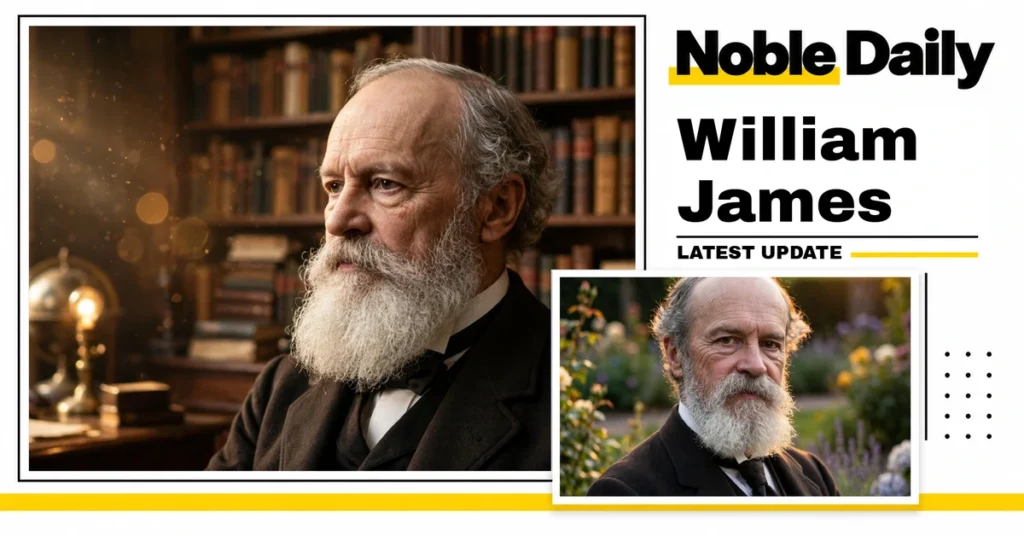
William James was an American philosopher and psychologist whose work helped shape modern psychology and pragmatism. A longtime Harvard professor, he explored how people think, feel, believe, and make choices. His books, especially The Principles of Psychology and The Varieties of Religious Experience, still influence scholars today.
Who Is William James?
William James (1842 to 1910) was a leading American thinker who connected the scientific study of the mind with questions about truth, freedom, religion, and human experience. He helped establish psychology as a university subject in the United States and became one of the founders of American pragmatism.
| Full name | William James |
| Born | January 11, 1842, in New York City |
| Died | August 26, 1910, in Chocorua, New Hampshire |
| Age at death | 68 |
| Nationality | American |
| Professions | Philosopher, psychologist, professor |
| Education | Medical degree, Harvard, 1869 |
| Spouse | Alice Howe Gibbens |
| Children | Five |
| Known for | Pragmatism and The Principles of Psychology |
How Old Was William James When He Died?
William James was 68 years old when he died on August 26, 1910. He was born on January 11, 1842, in New York City. He died at his family’s summer home in Chocorua, New Hampshire, after years of heart trouble.
A 1942 obituary in Nature gives August 27 as his death date. However, the Stanford Encyclopedia of Philosophy, historical records, and other biographical accounts use August 26. This biography follows the date supported by those sources.
What Was William James’s Early Life Like?
James grew up in an educated New York family that valued travel, art, books, and debate. His father, Henry James Sr., was a religious writer and thinker. His mother was Mary Walsh James. The family spent long periods in Europe, where William attended schools in Geneva, Paris, and other cities.
As a young man, James hoped to become a painter. He studied with American artist William Morris Hunt in Newport, Rhode Island, but left art within a year. He later turned to science and medicine. His younger brother Henry James became a major novelist, while his sister Alice James became known for her diaries.
Where Did William James Study and Teach?
James studied chemistry and anatomy at Harvard’s Lawrence Scientific School before entering Harvard Medical School. In 1865, he joined naturalist Louis Agassiz’s expedition to Brazil, where he collected specimens and became ill. After further study in Europe, he earned his medical degree in 1869 but never practiced medicine.
Harvard hired James to teach physiology in 1872. By 1875, he was teaching psychology and had established an experimental psychology laboratory. He later taught philosophy and psychology, and retired from Harvard in 1907.
Who Were William James’s Wife, Children, and Siblings?
James married Alice Howe Gibbens on July 10, 1878. Alice was a schoolteacher when they met. They had five children: Henry (1879), William (1882), Herman (1884 to 1885), Margaret Mary (1887), and Alexander Robertson (1890).
James was the oldest of five children. His younger siblings were Henry, Garth Wilkinson, Robertson, and Alice. His brother Henry, often called Henry James Jr., became a celebrated novelist. William and Henry followed different careers, but both became major figures in American intellectual life.
What Did William James Contribute to Psychology?
James helped make psychology a serious subject for university teaching and research in the United States. His 1890 book, The Principles of Psychology, examined attention, memory, habit, emotion, the will, and the sense of self. It combined observation, physiology, and philosophy rather than treating the mind as a collection of separate parts.
One of his best-known ideas was the stream of consciousness. James described thought as a moving flow that changes from moment to moment while retaining a sense of continuity.
He also described the self through the “I,” the part that knows, and the “Me,” the self a person can think about. The “Me” included material, social, and spiritual sides of identity.
James also helped shape functionalism. This approach asked what mental processes do and how they help people respond to their surroundings. The James-Lange theory of emotion, associated with James and Danish physiologist Carl Lange, proposed that bodily changes play a key role in emotion.
James served as president of the American Psychological Association in 1894 and 1904.
What Was William James’s Philosophy of Pragmatism?
James helped turn pragmatism into a major American philosophy. Pragmatism asks what practical difference an idea makes in experience. Instead of judging a belief only by how it sounds in theory, a person should examine its effects and results in real life.
James developed this approach in lectures and in his 1907 book Pragmatism. He did not mean that any useful claim must be true or that people should believe whatever they want. He argued that ideas are tested through experience and that understanding can change as new evidence appears.
His philosophy also explored free will and determinism. After a period of deep doubt in his twenties, James came to defend the possibility of human choice.
In The Will to Believe (1897), he argued that people may sometimes make a commitment when a choice is live, forced, and important, and when evidence cannot settle it in advance. He did not present this as permission to ignore evidence in ordinary factual questions.
What Did William James Write About Religion?
James studied religion as a part of human experience. His 1902 book The Varieties of Religious Experience grew from lectures he delivered at the University of Edinburgh in 1901 and 1902.
Rather than focusing mainly on churches or formal beliefs, he examined personal accounts of conversion, prayer, mystical states, and changes in a person’s sense of life.
The book considered different religious temperaments, including what James called the “healthy-minded” and the “sick soul.” He also discussed the mind-cure movement, which was linked to the wider New Thought tradition. James treated these movements as subjects for psychological study, not as systems he had founded.
James did not claim that psychology could prove every religious belief. He asked what religious experiences meant to the people who had them and what effects they produced. His approach brought scientific observation into conversation with spiritual questions.
What Are William James’s Most Important Books?
James wrote influential works in psychology, philosophy, religion, and social thought. His best-known books include:
- The Principles of Psychology (1890), his major study of attention, habit, emotion, and consciousness.
- The Will to Believe and Other Essays in Popular Philosophy (1897), on belief, faith, and moral choice.
- The Varieties of Religious Experience (1902), a study of personal religious life and mystical experience.
- Pragmatism (1907), his statement of the practical method in philosophy.
- A Pluralistic Universe (1909), an argument against treating reality as one finished, closed system.
His later essays on radical empiricism and pure experience were collected after his death in Essays in Radical Empiricism (1912). These writings explored the idea that experience includes both things and the relations between them.
Which William James Quotes Are Authentic?
One well-documented William James quote is, “My experience is what I agree to attend to.” It appears in Chapter XI, “Attention,” of The Principles of Psychology (1890). James used it to explain how attention selects some parts of the world and leaves others outside our immediate experience.
Many motivational sayings online are also credited to James, but not all have a traceable source in his books.
For example, the line about the greatest weapon against stress being the ability to choose one thought over another is often attributed to him, but a reliable original source has not been identified. Readers should check the original text before sharing a quote in his name.
Psychology’s founders each offered a different lens: explore Sigmund Freud, Carl Jung, Alfred Adler, John Watson, Ivan Pavlov, B. F. Skinner, Abraham Maslow, and Carl Rogers for more.
William James’s Death and Lasting Legacy
William James died of heart failure on August 26, 1910, at his summer home in Chocorua, New Hampshire. He was still working on philosophical questions and a book that was published after his death as Some Problems of Philosophy in 1911.
His influence reached beyond Harvard. Students such as Mary Whiton Calkins and Edward Thorndike became important psychologists. His ideas also shaped later thinkers in philosophy and psychology, including John Dewey, Bertrand Russell, and Ludwig Wittgenstein. James’s writing remains important because it connects the study of human behavior with questions people face in everyday life.
What Did James Mean by the Moral Equivalent of War?
James used the phrase “the moral equivalent of war” in an essay published in 1910. He believed that courage, discipline, shared effort, and service could be directed toward peaceful work instead of military conflict. He suggested that demanding public service could give people a common purpose without the destruction caused by war.
The essay did not simply dismiss the appeal of military life. James tried to understand why people valued its discipline and group loyalty, then asked whether a peaceful society could create similar forms of service. The phrase later became influential in debates about civic duty and nonmilitary public service.
What Is William James’s Legacy Today?
James remains a central figure in the history of American psychology and philosophy. His work helped establish psychology as a field of study, gave pragmatism a broad audience, and offered a lasting account of attention and consciousness. His books continue to be read in courses on psychology, philosophy, religion, and American intellectual history.