Sigmund Freud Biography | Theories, Books & Legacy
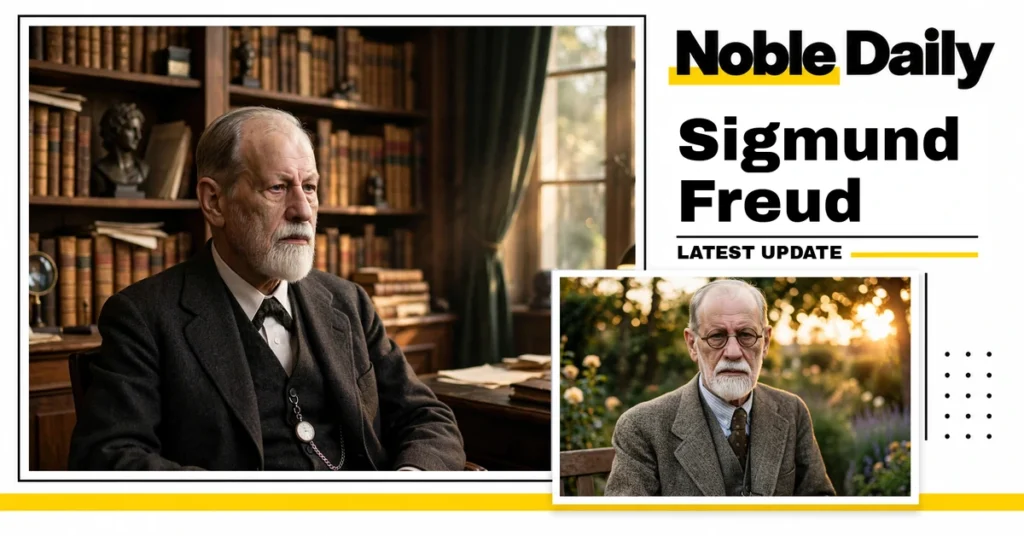
Sigmund Freud was an Austrian neurologist who founded psychoanalysis, a method for exploring unconscious thoughts, memories, and emotional conflict. Born in 1856, he spent most of his career in Vienna before fleeing Nazi persecution in 1938. His ideas changed how people discussed dreams, childhood, personality, and mental health.
Who Is Sigmund Freud?
Sigmund Freud was an Austrian physician and neurologist best known for founding psychoanalysis. His work shaped modern discussions of the unconscious mind, dreams, childhood, and personality. He spent most of his professional life in Vienna and moved to London in 1938 after Nazi Germany annexed Austria.
| Full name | Sigismund Schlomo Freud |
| Born | May 6, 1856 |
| Birthplace | Freiberg, Moravia, now Příbor, Czech Republic |
| Nationality | Austrian, born in the Austrian Empire |
| Profession | Neurologist, physician, and founder of psychoanalysis |
| Wife | Martha Bernays, married September 14, 1886 |
| Children | Six, including psychoanalyst Anna Freud |
| Known for | Psychoanalysis, dream interpretation, and theories of the unconscious |
| Died | September 23, 1939, in London, England |
| Age at death | 83 years |
Where Was Sigmund Freud Born and What Was His Early Life Like?
Sigmund Freud was born on May 6, 1856, in Freiberg, Moravia, a town now called Příbor in the Czech Republic. His father, Jacob, was a wool merchant, and his mother, Amalia, came from a Jewish family.
The family moved to Vienna in 1860, when Freud was still a young child. He grew up with five sisters and a younger brother. His father also had two sons from an earlier marriage. Freud was born Sigismund Schlomo Freud and began using the name Sigmund in 1875.
What Did Freud Study Before Becoming a Doctor?
Freud studied medicine at the University of Vienna and earned his medical degree in 1881. He first focused on science and research, working in the physiology laboratory of Ernst Brücke and studying the nervous system. He later trained in neurology and worked at Vienna General Hospital.
In 1885, a research grant took him to Paris, where he studied with neurologist Jean-Martin Charcot. Charcot’s use of hypnosis to explore hysteria helped Freud consider how mental experiences could produce physical symptoms.
After returning to Vienna in 1886, Freud opened a private practice for patients with nervous disorders. In 1891, he moved his practice to Berggasse 19, where he worked for 47 years. A group of doctors began meeting at his apartment in 1902, helping form the Vienna Psychoanalytic Society.
Freud also continued neurological research, including work on childhood cerebral palsy.
Who Were Sigmund Freud’s Wife and Children?
Freud married Martha Bernays on September 14, 1886, and they had six children: Mathilde, Jean-Martin, Oliver, Ernst, Sophie, and Anna. Their youngest child, Anna Freud, later became a leading psychoanalyst and helped develop the field of child psychoanalysis.
Freud’s family life also connected him to Edward Bernays, a pioneer of modern public relations. Edward was the son of Martha’s brother, making him Freud’s nephew by marriage.
What Was Sigmund Freud’s Religious Background?
Freud was born into a Jewish family but lived a secular life and did not practice Judaism. He continued to identify as Jewish, and his background later made him a target of Nazi persecution. His views on religion also shaped his writing, especially in works such as The Future of an Illusion.
How Old Was Sigmund Freud When He Died?
Freud was 83 years old when he died on September 23, 1939. He was born on May 6, 1856, so he had passed his 83rd birthday but had not reached his 84th.
How Did Sigmund Freud Develop Psychoanalysis?
Freud developed psychoanalysis as both a theory of the mind and a method of treating emotional distress. His early work grew from research into hypnosis and from his collaboration with Viennese physician Josef Breuer.
Their 1895 book, Studies on Hysteria, described how talking about painful memories could help patients understand and sometimes ease their symptoms. Freud began using the term psychoanalysis in 1896 and continued developing the method after he and Breuer separated professionally.
How Did Free Association and Transference Work?
Freud used free association to encourage patients to speak about whatever came to mind, including memories, dreams, worries, and seemingly unimportant thoughts. He believed that repeated themes, pauses, and resistance could reveal conflicts a patient did not fully recognize.
Freud also studied transference, in which a patient directs feelings connected to earlier relationships toward the analyst. He treated those feelings as useful material for understanding patterns in the patient’s life. These methods helped make the therapist-patient relationship central to psychoanalytic treatment.
What Were Sigmund Freud’s Most Famous Theories?
Freud’s best-known theories focused on unconscious mental activity, the influence of early childhood, and conflict between different parts of the personality. He argued that people are not always aware of the motives behind their choices. This belief challenged the idea that people fully understand why they act.
How Did Freud Explain the Unconscious, Dreams, and the Id, Ego, and Superego?
Freud believed that the unconscious mind could shape feelings and behavior even when people were not aware of its influence. He treated dreams, slips of the tongue, and recurring symptoms as possible signs of hidden conflict.
In The Interpretation of Dreams, he argued that dreams could express wishes in disguised forms. In 1923, he presented his structural model of personality in The Ego and the Id.
The id represented basic drives, the ego dealt with reality, and the superego represented internalized rules and moral standards. In Freud’s model, these three forces often pulled a person in different directions.
What Were Freud’s Psychosexual Stages and the Oedipus Complex?
Freud proposed five stages of psychosexual development and argued that early conflicts could affect adult personality. In his model, the stages were:
- Oral, when pleasure centered on sucking and feeding.
- Anal, when conflicts focused on elimination and control.
- Phallic, when children became focused on their bodies and the Oedipus complex.
- Latency, when sexual drives became less visible during middle childhood.
- Genital, when mature sexual interests developed during puberty.
Freud described the Oedipus complex as a child’s unconscious attraction to one parent and rivalry with the other. These ideas became some of his most debated claims.
Modern psychology does not accept the stages or the Oedipus complex as established universal facts, although the broader idea that early experiences can influence later development remains important in many fields.
Which Sigmund Freud Books Are Most Important?
Freud published more than twenty volumes of theoretical writing and clinical studies. His books introduced psychoanalysis to a wide audience and show how his ideas changed over time. These works are useful starting points for readers who want to understand his influence:
- Studies on Hysteria (1895), written with Josef Breuer, presented early work on talking through distressing memories.
- The Interpretation of Dreams was issued in late 1899 with a 1900 title-page date and explored dreams and the unconscious.
- The Psychopathology of Everyday Life (1901) examined slips and memory errors. Three Essays on the Theory of Sexuality (1905) explored infantile sexuality and development.
- Beyond the Pleasure Principle (1920) and The Ego and the Id (1923) developed his later ideas about drives and personality.
- Civilization and Its Discontents (1930) examined tensions between human desires and the demands of society.
Why Was Sigmund Freud Controversial?
Freud remains controversial because he gave sexuality, childhood experience, and unconscious conflict a central role in human behavior. Many readers found his ideas bold, while critics questioned his evidence and his broad claims about development. Some parts of his work influenced later therapy, but many specific Freudian explanations are not accepted as proven science today.
What Did Freud’s Cocaine Research and Cigar Habit Reveal About His Life?
Freud’s early cocaine research and lifelong cigar smoking became two notable, controversial parts of his medical history. In 1884, he published a study called Über Coca after experimenting with cocaine himself.
He discussed its possible medical uses but did not recognize how important its local anesthetic effect would become. The episode is now seen as a serious misjudgment in his early medical career. Freud was also a heavy cigar smoker.
He was diagnosed with cancer of the mouth in 1923, yet continued smoking during years of treatment and numerous operations. The Freud Museum London records 33 operations and preserves objects linked to his cigar habit.
A popular line, “Sometimes a cigar is just a cigar,” is often credited to Freud, but the museum says there is no evidence that he said or wrote it.
How Did Freud Escape Nazi Austria and Die in London?
Freud escaped Nazi Austria in 1938, after Nazi Germany annexed the country. His home was raided, and the regime seized money from the family. International pressure helped secure permission for Freud to leave for England with Martha, Anna, and members of his household.
He settled at 20 Maresfield Gardens in London, where he spent the final year of his life. Several of his sisters remained in Nazi-controlled Europe and were later murdered in the Holocaust.
What Caused Sigmund Freud’s Death?
Freud died from complications of advanced jaw and mouth cancer on September 23, 1939, in London. By 1939, the cancer was inoperable and his pain had become intense. At Freud’s request, his physician Max Schur gave him morphine to end his suffering. His former London home is now the Freud Museum London.
Psychology’s founders each offered a different lens: explore Carl Jung, Alfred Adler, William James, John Watson, Ivan Pavlov, B. F. Skinner, Abraham Maslow, and Carl Rogers for more.
What Is Sigmund Freud’s Legacy?
Freud’s legacy is complex but far-reaching. He made the unconscious mind, dreams, childhood experience, and the therapeutic relationship major subjects of public and academic debate. His work influenced psychology, psychiatry, literature, art, and cultural criticism.
Psychoanalysis later divided into many schools, and modern psychodynamic approaches changed many of Freud’s original ideas. Some of his theories about sexuality and personality are no longer accepted in their original form. Still, his impact on how people discuss inner life is difficult to ignore.
Museums in London and Vienna preserve places connected to his life and work.