B. F. Skinner | Biography, Theories, Books & Legacy
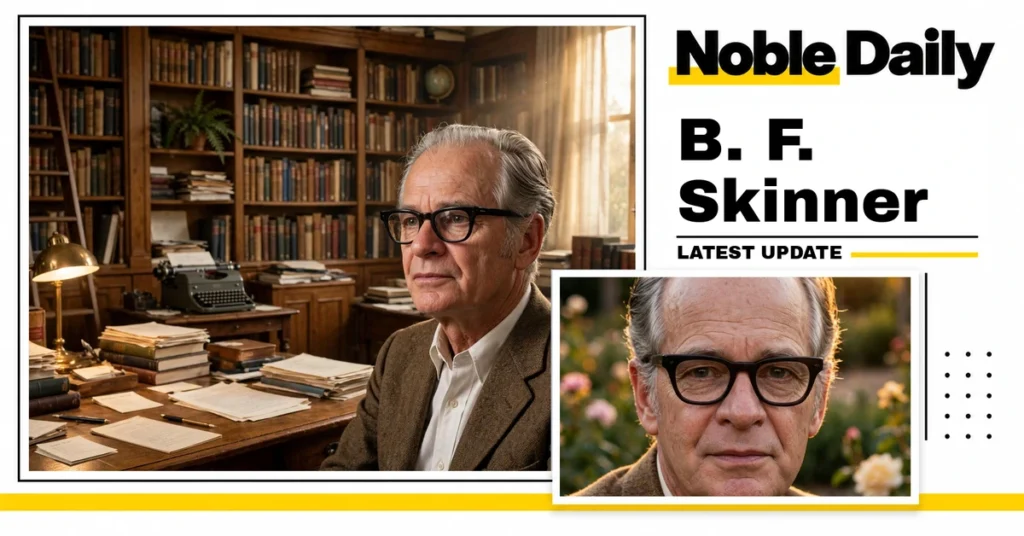
B. F. Skinner was an American psychologist whose research transformed the study of learning and behavior. Best known for developing the science of operant conditioning, he showed how consequences can strengthen or weaken actions. His experiments, books, teaching ideas, and debates about freedom made him one of the most influential psychologists of the 20th century.
Who Is B. F. Skinner?
B. F. Skinner, born Burrhus Frederic Skinner, was a leading American psychologist and a major figure in behaviorism. He studied how actions change through their consequences and applied those findings to animal learning, education, language, and social life. His work helped shape modern behavior analysis and remains widely discussed in psychology.
| Full name | Burrhus Frederic Skinner |
| Date of birth | March 20, 1904 |
| Date of death | August 18, 1990 |
| Age at death | 86 years |
| Birthplace | Susquehanna, Pennsylvania, United States |
| Nationality | American |
| Education | Hamilton College; Harvard University |
| Profession | Psychologist, author, and professor |
| Wife | Yvonne Eve Blue, married November 1, 1936 |
| Children | Two daughters, Julie and Deborah |
| Known for | Operant conditioning, radical behaviorism, and the Skinner box |
| Cause of death | Leukemia |
| Net worth | No reliable public estimate is available |
What Is B. F. Skinner Best Known For?
Skinner is best known for his experimental work on operant conditioning, a form of learning in which the consequences of an action affect the chance that it will happen again. His research gave psychologists a practical way to study behavior under controlled conditions.
A correct summary of his work is that he showed how reinforcement and other consequences shape behavior. He did not invent all of behaviorism, and his work was different from Ivan Pavlov’s research on classical conditioning. Skinner built on earlier ideas and developed a detailed experimental science of behavior.
When Was B. F. Skinner Born, and How Old Was He When He Died?
Skinner was born on March 20, 1904, in Susquehanna, Pennsylvania. He died on August 18, 1990, at the age of 86. These dates are consistent: he had turned 86 five months before his death.
His death was reported in Cambridge, Massachusetts. Contemporary obituaries identified leukemia as the cause. Because Skinner died in 1990, his age should be described as his age at death, not as a current age.
What Were B. F. Skinner’s Early Life and Education?
Skinner grew up in Susquehanna, Pennsylvania, and studied English at Hamilton College before earning graduate degrees in psychology at Harvard. His father, William Arthur Skinner, was an attorney, and his mother was Grace Madge Burrhus. As a boy, he enjoyed building mechanical devices and reading literature, science, and philosophy.
He studied English language and literature at Hamilton College in Clinton, New York, from 1922 to 1926. After graduation, he tried to become a fiction writer and spent time working in a New York City bookstore. His interest shifted toward psychology after he read about John B.
How Did B. F. Skinner Build His Academic Career?
Skinner began his academic career as a researcher at Harvard and later held faculty and leadership roles at the University of Minnesota and Indiana University. He returned to Harvard in 1948 and remained there for the rest of his professional life.
The main stages of his career were:
- 1931: Earned his Ph.D. at Harvard and continued research there.
- 1936: Joined the psychology faculty at the University of Minnesota.
- 1945: Became chair of the psychology department at Indiana University.
- 1958 to 1974: Served as the Edgar Pierce Professor of Psychology at Harvard.
Who Was B. F. Skinner’s Wife, and Did He Have Children?
Skinner married Yvonne Eve Blue on November 1, 1936. The couple had two daughters, Julie and Deborah, and built their family life while Skinner moved between university appointments.
His family became part of public discussion because of the temperature controlled air crib he designed for their younger daughter, Deborah. The device later attracted rumors that were not supported by the family’s account or the historical record.
What Is Operant Conditioning, and How Did the Skinner Box Work?
Operant conditioning is learning through consequences, and Skinner studied it in a chamber that recorded how animals responded to actions and rewards. If a consequence makes an action more likely to happen again, it functions as reinforcement. If it makes the action less likely, it functions as punishment.
Skinner studied these processes with an experimental chamber later called the Skinner box. In a common setup, a rat could press a lever or a pigeon could peck a key to receive food. The equipment recorded responses and allowed researchers to control when consequences appeared.
Skinner also studied shaping, in which a researcher reinforces small steps that move an animal toward a more complex action. This method helped show how a new behavior could develop gradually rather than appearing all at once.
How Do Positive and Negative Reinforcement Differ From Punishment?
Positive and negative reinforcement both increase a behavior, while punishment is intended to reduce it. The words positive and negative describe whether something is added or removed. They do not mean good and bad.
Positive reinforcement adds a consequence that strengthens an action, such as giving a student praise after a correct answer. Negative reinforcement removes an unpleasant condition after an action, such as stopping an irritating sound when a person fastens a seat belt. Punishment works in the opposite direction by reducing the chance of a behavior.
Skinner and researcher Charles B. Ferster also studied schedules of reinforcement. A fixed-ratio schedule delivers reinforcement after a set number of responses, while a variable-ratio schedule uses a changing number of responses.
A fixed-interval schedule makes reinforcement available after a set amount of time, while a variable-interval schedule uses changing time periods. These patterns help explain why some behaviors remain steady while others rise and fall.
What Is Radical Behaviorism, and What Did Skinner Believe About Free Will?
Radical behaviorism was Skinner’s philosophy of psychology, and he argued that behavior is shaped by biological history and environment rather than by an independent inner will. It treated public actions and private events, such as thoughts and feelings, as part of the subject matter of behavior science.
This point set it apart from approaches that excluded private experience from scientific discussion.
Skinner argued that behavior has causes in a person’s biological history and environment, including past consequences. He questioned the idea that an independent inner self explains actions without itself needing explanation. This view is often described as determinist, but Skinner’s goal was to understand behavior and improve the conditions that shape it.
His arguments about free will and personal responsibility drew strong criticism. Supporters saw a scientific way to address social problems, while critics worried that his approach could weaken individual choice and justify too much control by institutions.
What Were Project Pigeon and Skinner’s Teaching Machine?
Project Pigeon was Skinner’s World War II effort to use trained pigeons to guide a weapon toward a target, while his teaching machine presented lessons in small steps with immediate feedback.
The birds learned to peck at an image of a target, and their responses could direct the guidance system. The military did not deploy the pigeon guided weapon, but the project showed how Skinner applied behavioral research to a practical problem.
Skinner also developed teaching machines in the 1950s. These devices presented one question at a time, let students enter an answer, and then showed feedback. One version, built in 1957, was used in a Harvard natural sciences course.
His approach encouraged students to learn in small steps and move at an individual pace. The machines were not widely adopted, but programmed instruction influenced later educational methods.
What Was B. F. Skinner’s Air Crib, and What Happened to His Daughter Deborah?
The air crib was a temperature-controlled, glass-sided infant enclosure that Skinner designed for his family, and his daughter Deborah later said the device did not harm her. It circulated warm, filtered air and gave a baby room to move without the usual layers of clothing and blankets.
It was a household device, not an experimental chamber used to test psychological theories on a child.
His daughter Deborah spent much of her first two and a half years in the crib. In a 2004 first person account, she rejected stories that she had been harmed, institutionalized, or driven to suicide by the device. She described a loving childhood and said she had not been used as a laboratory subject.
Which Books Did B. F. Skinner Write?
Skinner wrote influential research books, teaching works, social commentary, and fiction. Several titles remain central to the history of behavior analysis:
- The Behavior of Organisms (1938) presented his experimental approach to behavior.
- Walden Two (1948) imagined a community shaped by behavioral principles.
- Science and Human Behavior (1953) applied his ideas to everyday human activity.
- Verbal Behavior (1957) examined language through a behaviorist framework.
- The Technology of Teaching (1968) explained how learning could be organized in steps.
- Beyond Freedom and Dignity (1971) explored the social meaning of behavior science.
- About Behaviorism (1974) clarified the ideas behind his approach.
Why Was Beyond Freedom and Dignity Controversial?
The book became controversial because many readers saw its argument as a threat to personal freedom and human dignity. Critics feared that planned behavior control could become authoritarian. Skinner argued that social environments already shape behavior and that carefully designed systems could rely more on positive reinforcement and less on punishment.
His earlier novel Walden Two, published in 1948, explored a fictional community organized around behavioral principles. The novel helped readers imagine how his ideas might work outside a laboratory, while also raising questions about who should design and manage such a community.
What Awards Did B. F. Skinner Receive, and What Is His Legacy?
Skinner received major honors for his influence on psychology, and his work helped establish behavior analysis as a major field. His awards included the National Medal of Science in 1968, the American Psychological Association’s Distinguished Scientific Contribution Award in 1958, and its Gold Medal Award in 1971.
In August 1990, the APA gave him its first Citation for Outstanding Lifetime Contribution to Psychology. His work helped establish behavior analysis as a field with experimental, theoretical, and applied branches. Its methods influenced education, clinical work, and programs that teach new skills or reduce harmful behavior.
His legacy is not free from debate. Psychology later gave more attention to cognition and mental processes, and critics continue to challenge parts of his account of human action. Even so, the terms reinforcement, shaping, and operant conditioning remain important in psychology and education.
What Was B. F. Skinner’s Cause of Death?
Skinner died of leukemia on August 18, 1990, in Cambridge, Massachusetts. He was 86. His death came after a long career of research, teaching, writing, and public debate about how people learn and how societies influence behavior.
Psychology’s founders each offered a different lens: explore Sigmund Freud, Carl Jung, Alfred Adler, William James, John Watson, Ivan Pavlov, Abraham Maslow, and Carl Rogers for more.
B. F. Skinner’s Lasting Influence
B. F. Skinner changed psychology by showing how behavior could be studied through careful experiments and explained through its consequences. His theories remain influential in learning and behavior analysis, while his views on freedom and social control continue to invite debate. That combination of practical impact and lasting controversy keeps his work relevant.