Carl Rogers | Biography, Theory, Books & Lasting Legacy
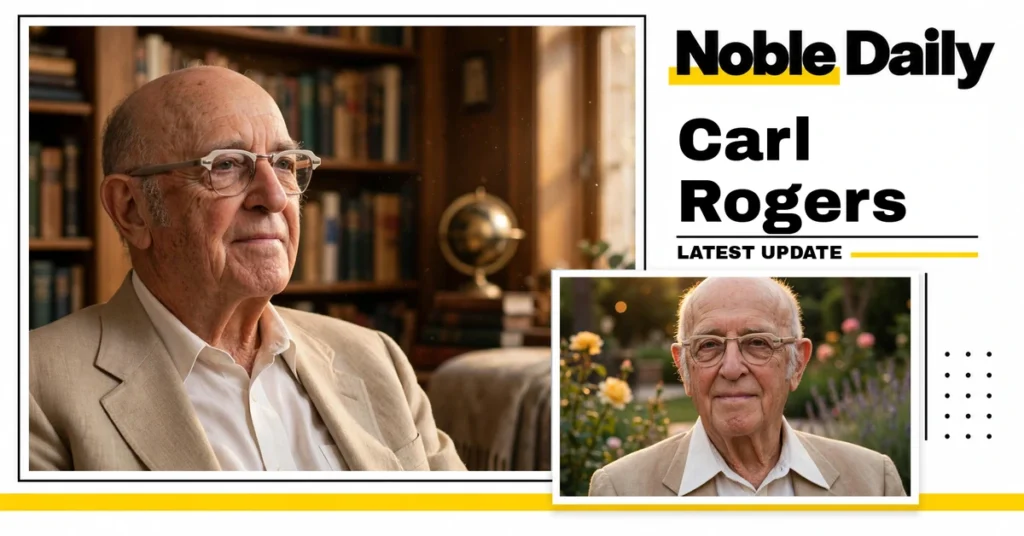
Carl Rogers, who lived from 1902 to 1987, was an American psychologist whose person-centered approach reshaped psychotherapy, counseling, and education. He believed people could grow when met with empathy, honesty, and acceptance rather than judgment. His research, books, and peace work made him a leading figure in humanistic psychology.
Who Is Carl Rogers?
Carl Ransom Rogers was an American psychologist and psychotherapist best known for developing client-centered, later person-centered, therapy. He helped establish humanistic psychology and argued that a trusting relationship could support personal change. His research also helped make psychotherapy more systematic by recording sessions and studying their outcomes.
| Full name | Carl Ransom Rogers |
| Born | January 8, 1902 |
| Birthplace | Chicago, Illinois (some local accounts say Oak Park) |
| Died | February 4, 1987 |
| Age at death | 85 |
| Nationality | American |
| Profession | Psychologist, psychotherapist, educator |
| Known for | Humanistic psychology and person-centered therapy |
| Wife | Helen Elliott Rogers |
| Children | David and Natalie Rogers |
| Height and net worth | Not reliably documented |
When Was Carl Rogers Born and What Was His Cause of Death?
Rogers was born on January 8, 1902, and died on February 4, 1987, in La Jolla, California, at age 85.
The University of California, Santa Barbara archive and Oxford’s American National Biography place his birth in Chicago, while some local accounts give Oak Park, the suburb where he grew up. The UCSB archive records cardiac arrest after hospitalization for a broken hip as his cause of death.
What Was Carl Rogers’s Early Life and Family Like?
Rogers grew up in Oak Park and on a family farm outside Chicago. His parents, Walter Rogers and Julia Cushing, raised their children in a strict Protestant home that valued religion, education, and self-discipline. Farm experiments helped build his interest in careful observation.
In 1922, he joined a six-month trip to China as one of ten American delegates to a World Student Christian Federation gathering in Peking. The experience exposed him to new beliefs and cultures and led him to question parts of his inherited religious outlook.
Where Did Carl Rogers Study and How Did He Enter Psychology?
Rogers graduated from the University of Wisconsin-Madison in 1924 with a bachelor’s degree in history, after first studying agriculture. He entered Union Theological Seminary to prepare for ministry, but found that counseling and psychology interested him more.
In 1926, he transferred to Teachers College at Columbia University, earning a master’s degree in 1927 and a doctorate in 1931. He studied clinical and educational psychology, and his work with children helped shape his focus on supportive relationships.
How Did Carl Rogers Build His Career and Become APA President?
Rogers began as a child psychologist at the Rochester Society for the Prevention of Cruelty to Children in 1928 and later led its Child Study Department. His book The Clinical Treatment of the Problem Child appeared in 1939. In 1940, he became a full professor at Ohio State University.
At Ohio State, he published Counseling and Psychotherapy in 1942 and established a supervised counseling practicum in an academic psychology department. In 1945, he moved to the University of Chicago to start a counseling center. There, he used recordings and client measures to study therapy, helping bring systematic research into the field.
Rogers served as president of the American Psychological Association in 1947. He joined the University of Wisconsin-Madison in 1957, moved to La Jolla in 1964, and helped establish the Center for Studies of the Person in 1968.
His honors included the APA Award for Distinguished Scientific Contributions in 1956, the APA’s first Distinguished Professional Contribution Award in 1972, and Humanist of the Year from the American Humanist Association in 1964.
What Is Carl Rogers’s Person-Centered Theory?
Rogers’s humanistic theory held that people have an inborn actualizing tendency, a basic movement toward maintaining life and developing their abilities. Supportive relationships can help this growth, while rejection and rigid expectations can obstruct it. His theory explored how people form a sense of self and what happens when lived experience conflicts with that self-image.
In Client-Centered Therapy (1951), Rogers presented 19 propositions about personality and behavior. They describe each person’s phenomenal field, or the world as that individual experiences it, and explain how self-concept and the need for positive regard shape behavior.
When people hide parts of themselves to earn approval, they may experience incongruence between their feelings and self-image.
Rogers called the person’s ongoing sense of which experiences support growth the organismic valuing process. He described self-actualization as the development of human potential. A fully functioning person was not perfect or finished, but open to experience, able to trust personal judgment, flexible, creative, and willing to keep growing.
How Did Client-Centered Therapy Use Empathy and Unconditional Positive Regard?
Client-centered therapy places the client’s experience at the center of treatment. Rather than directing every conversation or handing out ready-made answers, the therapist creates a respectful setting where clients can explore feelings and make their own choices. Rogers first called the approach nondirective and later used client-centered and person-centered.
He identified three therapist attitudes as especially important:
- Empathy means understanding the client’s inner point of view and communicating that understanding.
- Unconditional positive regard means valuing the client without making acceptance depend on agreement or approval of every action.
- Congruence means the therapist is genuine and present rather than hiding behind a professional mask.
In a 1957 paper, Rogers set out six conditions for constructive personality change. They included psychological contact, the client’s incongruence, therapist congruence, unconditional positive regard, empathy, and the client’s ability to receive that understanding.
Later reviews linked each condition with positive outcomes but noted that the six together had not been conclusively proved necessary and sufficient in every case.
What Did Carl Rogers Believe About Education and Learning?
Rogers believed students learn best when they take an active role. In Freedom to Learn (1969), he argued that teachers should guide discovery, encourage curiosity, and create a safe climate for questions. The teacher acts as a facilitator, bringing knowledge and structure while helping students take responsibility for learning.
This student-centered approach carried his ideas beyond therapy into classrooms and adult education. Rogers believed education should help people keep learning and adapting, not simply memorize facts for tests.
Who Was Carl Rogers’s Wife and How Many Children Did He Have?
Rogers married Helen Elliott on August 28, 1924. They had two children, David Elliott Rogers, born March 17, 1926, and Natalie Rogers, born October 9, 1928. Natalie later worked with her father on person-centered workshops about communication, creativity, and personal growth.
Helen died on March 29, 1979, after more than five decades of marriage. Rogers was a widower for nearly eight years before his own death.
Which Books Did Carl Rogers Write?
Rogers wrote influential books on child guidance, psychotherapy, personal growth, education, and group relationships. His best-known works include:
- The Clinical Treatment of the Problem Child (1939), an account of his work with children.
- Counseling and Psychotherapy (1942), which introduced his developing nondirective approach.
- Client-Centered Therapy (1951), his major statement of the method and its theory.
- On Becoming a Person (1961), a widely read collection of essays on therapy and human relationships.
- Freedom to Learn (1969), Carl Rogers on Encounter Groups (1970), and A Way of Being (1980), which extended his ideas into education, group work, and everyday life.
How Did Carl Rogers Work for Peace and Was He Nominated for the Nobel Peace Prize?
In the 1970s and 1980s, Rogers applied person-centered ideas to conflict outside therapy. He brought people from opposing communities into dialogue, including Protestant and Catholic participants in Northern Ireland and Black and white participants in South Africa. He also led workshops in other countries to encourage communication across political and cultural divisions.
At the Rust Peace Workshop in Austria in November 1985, Rogers helped bring together 65 leaders from 17 countries to discuss conflict in Central America. A University of California, Santa Barbara archival chronology records that U.S.
Congressman Jim Bates nominated Rogers for the Nobel Peace Prize on January 30, 1987, five days before his death. A 2025 scholarly analysis, however, describes the nomination effort as still being drafted before his death.
The Nobel institution keeps nomination records confidential for 50 years, so the exact official status cannot be confirmed publicly. Rogers did not receive the prize.
What Is Carl Rogers’s Legacy in Psychology Today?
Rogers’s lasting contribution was to make the human relationship central to helping people change. His person-centered approach and emphasis on empathy, acceptance, authenticity, and client choice influenced counseling, psychotherapy training, education, and organizational development. His research also helped establish the value of recording and studying therapy sessions with client consent and privacy safeguards.
His approach has faced debate. Some critics argue that nondirective therapy can offer too little structure for clients who need active guidance. Others question how broadly the actualizing tendency can explain human behavior. Research continues to examine which parts of the approach matter most rather than treating every claim as settled.
A 2025 scholarly analysis explored the gap between Rogers’s ideal of congruence and his personal relationships. Drawing on a recollection by his daughter Natalie, the author noted that Rogers was skilled at listening but did not always express his own thoughts and feelings openly.
This adds nuance to his story: his ideas were demanding human ideals, not proof that he had mastered every one of them.
A line from On Becoming a Person captures his view of growth: “The good life is a process, not a state of being. It is a direction, not a destination.” It reflects his belief that personal development does not end when someone reaches a fixed goal.
Psychology’s founders each offered a different lens: explore Sigmund Freud, Carl Jung, Alfred Adler, William James, John Watson, Ivan Pavlov, B. F. Skinner, and Abraham Maslow for more.
Conclusion
Carl Rogers changed psychology by shifting attention from expert control to the conditions that help people understand themselves and grow. His person-centered approach, research, books, and peace work gave lasting influence to empathy, acceptance, and genuine human connection. His legacy remains important because it treats each person as an active participant in change.