Niels Bohr Biography | Atomic Model, Nobel Prize & Legacy
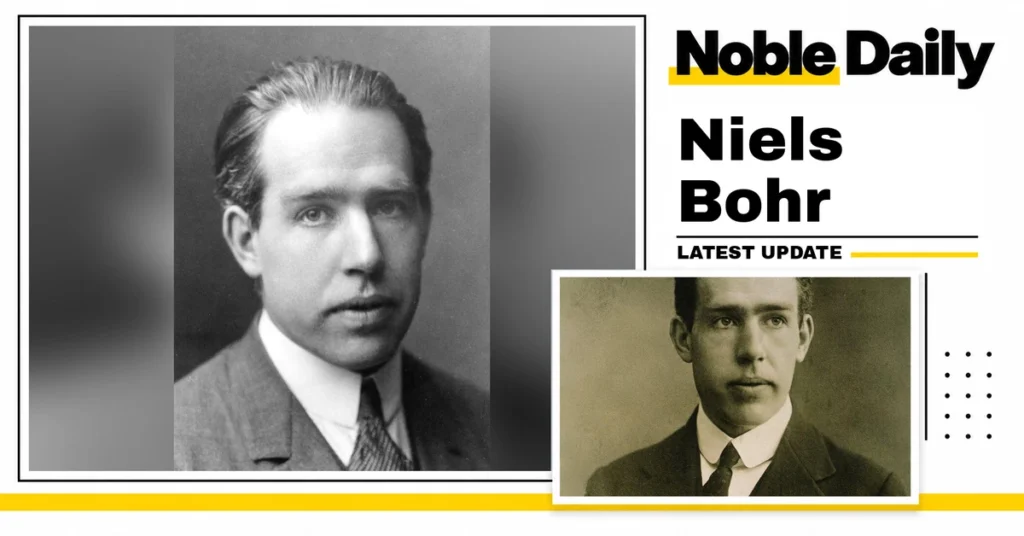
Niels Bohr was a Danish physicist whose 1913 atomic model helped explain how atoms absorb and release light.
A major figure in the rise of quantum theory, he received the 1922 Nobel Prize in Physics and built a research center in Copenhagen that shaped generations of scientists. His later work also addressed the risks of nuclear weapons.
Who Is Niels Bohr?
Niels Henrik David Bohr was a theoretical physicist whose ideas helped transform atomic physics and the study of matter. He combined experimental evidence with quantum ideas to explain features of atoms that classical physics could not.
Beyond research, he created a place where scientists could challenge one another’s ideas and develop the new science of quantum mechanics.
| Full name | Niels Henrik David Bohr |
| Born | October 7, 1885, Copenhagen, Denmark |
| Died | November 18, 1962, Copenhagen, Denmark |
| Age at death | 77 |
| Nationality | Danish |
| Profession | Theoretical physicist |
| Known for | Atomic model, quantum theory, complementarity, nuclear physics |
| Nobel Prize | 1922 Nobel Prize in Physics |
| Wife | Margrethe Nørlund, married August 1, 1912 |
| Children | Six sons, including physicist Aage Bohr |
| Research institute | Institute for Theoretical Physics, University of Copenhagen |
| Burial | Assistens Cemetery, Copenhagen |
| Net worth | No reliable estimate is documented |
What Was Niels Bohr Famous For?
Niels Bohr is best known for his atomic model, his work on quantum theory, and his role in building modern theoretical physics. His research helped explain why atoms absorb and emit light at specific energies, a problem that classical physics could not fully solve.
Before Bohr, Ernest Rutherford’s nuclear model had a major problem. Classical physics suggested that electrons circling a nucleus should lose energy and spiral inward. Bohr proposed that electrons could occupy only certain allowed energy states. This helped explain why hydrogen emits light at specific wavelengths rather than across a continuous range.
Bohr’s influence extended beyond a single model. He shaped a research community where physicists could question established ideas and test new ones. That environment helped turn quantum physics from a set of difficult problems into a wider scientific framework.
How Did Niels Bohr’s Atomic Model Change Physics?
Bohr’s 1913 model pictured electrons occupying only certain permitted orbits around a small, positively charged nucleus. In the model, an electron could not take just any energy value. When it moved from a higher allowed state to a lower one, it released a quantum of energy as light.
When it absorbed the right amount of energy, it could move to a higher state. This explained important features of hydrogen’s line spectrum and linked atomic structure to measurable observations.
Bohr adapted Rutherford’s nuclear atom and Max Planck’s idea that energy is quantized. His theory worked especially well for hydrogen, but it could not accurately describe atoms with many electrons. Modern quantum mechanics describes electrons through probability distributions rather than fixed tracks.
Even so, the Bohr model remains a useful teaching tool and a landmark in the development of atomic theory.
How Did Bohr’s Education Lead to His Scientific Breakthroughs?
Bohr began studying at the University of Copenhagen in 1903, earned a master’s degree in physics in 1909, and completed his doctorate in 1911. His doctoral work examined the electron theory of metals, showing that he was already interested in how microscopic particles shaped the behavior of matter.
In 1908, he won a prize from the Academy of Sciences in Copenhagen for an experimental study of surface tension using oscillating fluid jets. After completing his doctorate, he traveled to England and worked at Cambridge’s Cavendish Laboratory with J. J. Thomson. He later moved to Manchester, where he worked with Ernest Rutherford.
Rutherford’s nuclear model and Planck’s quantum ideas gave Bohr key pieces for his 1913 atomic theory.
How Did the Niels Bohr Institute Shape Quantum Physics?
Bohr became professor of theoretical physics at the University of Copenhagen in 1916 and helped establish the Institute for Theoretical Physics, which opened in 1921 and later became the Niels Bohr Institute.
The institute became an international center for research into atomic and quantum physics. Bohr encouraged open discussion, close collaboration, and careful debate rather than strict agreement with a senior scientist. Researchers including Werner Heisenberg and Wolfgang Pauli took part in the lively scientific culture around Copenhagen.
The institute’s influence became part of Bohr’s legacy because the new quantum mechanics developed through shared work as well as individual discoveries.
What Was Niels Bohr’s Role in Quantum Theory?
Bohr helped shape the interpretation of quantum mechanics through the principle of complementarity, which says that different experimental setups can reveal different but necessary aspects of a physical system. For example, light can show wave-like or particle-like behavior depending on how it is measured.
Bohr developed this idea publicly in 1927 as physicists tried to make sense of the new mathematical theories of quantum mechanics. The Copenhagen interpretation grew from discussions among Bohr and other scientists, including Heisenberg and Pauli.
It is not simply a single formula created by one person, and its meaning has continued to be debated by physicists and philosophers.
Why Did Niels Bohr and Albert Einstein Disagree?
Bohr and Albert Einstein disagreed about what quantum mechanics could tell us about physical reality. Einstein questioned whether the theory gave a complete account of nature, especially because it described outcomes in terms of probabilities. Bohr argued that quantum mechanics offered the strongest account possible based on the results of carefully designed experiments.
Their famous exchanges at the Solvay Conferences in 1927 and 1930 included thought experiments about measurement, certainty, and the behavior of particles. The disagreement was serious but intellectually productive.
Einstein’s challenges pushed Bohr and other physicists to explain the theory more clearly, while Bohr’s replies helped define the questions that still shape debates about quantum physics.
Who Was Niels Bohr’s Wife, and How Many Children Did They Have?
Bohr married Margrethe Nørlund on August 1, 1912. They had six sons. Two died before him, while the other four built careers in different fields. Their son Aage Bohr became a theoretical physicist and shared the 1975 Nobel Prize in Physics for research on the structure of atomic nuclei.
Margrethe was a close partner in Bohr’s family life and helped create the welcoming home where visiting scientists often gathered. The couple’s marriage lasted 50 years, ending with Bohr’s death in 1962. Their family story also reflects how closely his scientific work was tied to the international community that formed around his institute.
What Did Niels Bohr Contribute to Nuclear Physics?
Bohr’s contributions extended from the atom’s electrons to the structure of its nucleus. In the 1930s, he helped develop ways to understand nuclear reactions.
With physicist John Archibald Wheeler, he used a liquid drop model of the nucleus to explain important features of nuclear fission, the process in which a heavy nucleus splits into smaller parts.
Bohr also helped clarify why uranium-235 was especially important in fission caused by slow neutrons. These ideas mattered to basic research and to the wartime development of nuclear weapons. They show how his work moved from explaining atomic spectra to questions with major scientific and political consequences.
What Awards and Achievements Did Niels Bohr Receive?
Bohr received the 1922 Nobel Prize in Physics for his investigations of atomic structure and the radiation atoms emit. The award recognized the importance of his research rather than a single device or invention. He later received other major honors for his scientific work and public service.
His best-known honors included the following:
- 1922 Nobel Prize in Physics for research on atomic structure and radiation.
- 1938 Copley Medal from the Royal Society, one of the society’s major scientific honors.
- 1947 Order of the Elephant, Denmark’s highest-ranking order of chivalry.
- 1957 Atoms for Peace Award for work connected with the peaceful use of atomic energy.
Why Did Niels Bohr Escape Denmark During World War II?
Bohr escaped German-occupied Denmark in 1943, reaching Sweden shortly before he was at risk of arrest. He then traveled to Britain and the United States. In Britain, he worked with the Tube Alloys program, and he later advised the Manhattan Project at Los Alamos under the name Nicholas Baker.
Although he advised scientists involved in building the atomic bomb, Bohr was deeply concerned about the political dangers of nuclear weapons. He argued for international cooperation and greater openness about atomic energy, warning that secrecy could contribute to an arms race.
In 1944, he met President Franklin D. Roosevelt to urge discussions between the Allied powers about the postwar future of atomic weapons.
After returning to Denmark in 1945, Bohr continued to support peaceful uses of atomic energy and international cooperation. In 1950, he sent an open letter to the United Nations calling for a more open exchange of scientific and technical information between nations.
When Did Niels Bohr Die, and Where Is He Buried?
Bohr died in Copenhagen on November 18, 1962, at the age of 77. He is buried at Assistens Cemetery in Copenhagen. Reliable institutional biographies confirm his death date and burial place but do not give a clear, consistent medical cause of death, so a specific cause should not be stated as fact.
Is Niels Bohr’s Net Worth Known?
No reliable estimate of Niels Bohr’s net worth is documented. He was a twentieth-century academic physicist and public science leader, and credible biographies focus on his research, teaching, and public service rather than a personal fortune. Exact figures published without reliable estate records should be treated as speculation.
To continue this set of physicist biographies, explore the stories of Stephen Hawking, Albert Einstein, Isaac Newton, Michael Faraday, James Clerk Maxwell, Max Planck, Werner Heisenberg, Erwin Schrödinger, Paul Dirac, and Roger Penrose.
Conclusion
Niels Bohr changed physics by showing how quantum ideas could explain the structure of atoms and by helping build a community that developed modern quantum mechanics. His atomic model was later refined, but it opened a path toward a deeper understanding of matter.
His work on nuclear physics, his Nobel Prize, and his efforts to encourage international cooperation made his legacy scientific as well as human.