Stephen Hawking | Biography, Discoveries, Books & Legacy
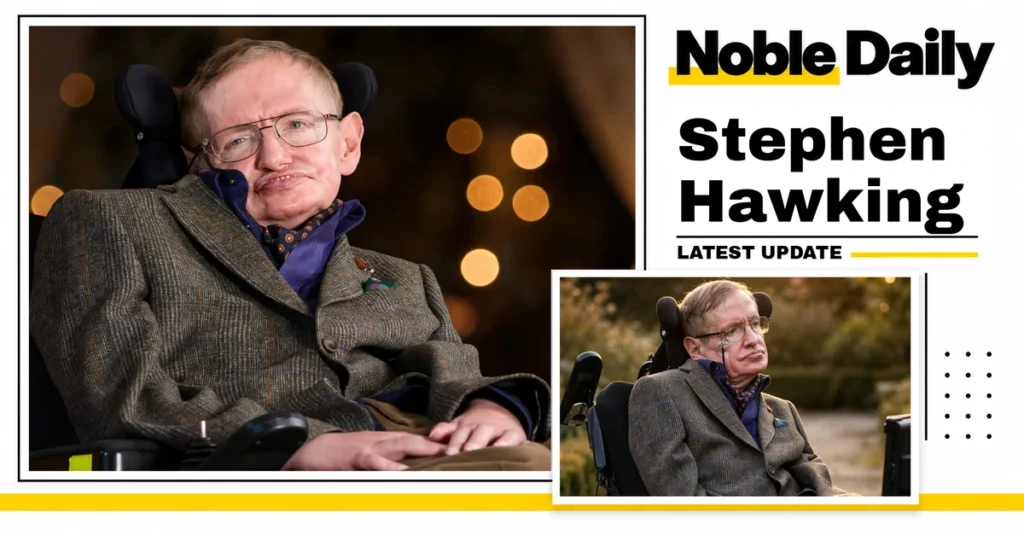
Stephen Hawking was a British theoretical physicist whose work reshaped modern understanding of black holes, the Big Bang, and the laws of the universe.
Despite living for decades with a rare, slow-progressing form of motor neurone disease, he became one of the world’s best-known scientists through his research, bestselling books, public lectures, and unmistakable computerized voice.
Who Is Stephen Hawking?
Born in Oxford in 1942, Hawking built his career at the University of Cambridge, where he explored how gravity and quantum physics shape the cosmos. His prediction of Hawking radiation and his gift for explaining complex ideas to general readers made him a major figure in science.
| Full Name | Stephen William Hawking |
| Born | January 8, 1942, Oxford, England |
| Died | March 14, 2018, Cambridge, England |
| Age at Death | 76 |
| Nationality | British |
| Field | Theoretical physics and cosmology |
| Education | University of Oxford and University of Cambridge |
| Known For | Hawking radiation, black-hole physics, cosmology, and science writing |
| First Wife | Jane Wilde, married in 1965 |
| Children | Robert, Lucy, and Timothy |
| Major Book | A Brief History of Time, published in 1988 |
| Nobel Prize | Never received the Nobel Prize in Physics |
Early Life and Education
Stephen William Hawking was born to Frank and Isobel Hawking and grew up mainly in Highgate, London, and St Albans, Hertfordshire. He attended St Albans School, where classmates called him “Einstein,” although he later recalled that he was not always near the top of his class.
He became interested in how the universe worked and chose science over his father’s preferred field of medicine.
Hawking entered University College, Oxford, in 1959 to study natural sciences. He earned a first-class degree in physics and moved to Trinity Hall, Cambridge, in 1962 for postgraduate research. There, he studied cosmology under Dennis Sciama and completed his doctoral thesis, Properties of Expanding Universes, in 1966.
As a student, he also enjoyed rowing and served as a coxswain for a college team.
How Old Was Stephen Hawking When He Died?
Hawking was born on January 8, 1942, and died on March 14, 2018, at the age of 76. His death came more than 55 years after doctors diagnosed him with motor neurone disease at 21. His life spanned a period of major change in modern physics, computing, and public access to scientific ideas.
What Disease Did Stephen Hawking Have?
Hawking was diagnosed in 1963 with motor neurone disease, commonly associated with amyotrophic lateral sclerosis, or ALS. The condition gradually damaged the nerves that controlled his voluntary muscles. Doctors initially believed he might live only a few more years, but his illness progressed unusually slowly.
The disease eventually limited his movement and speech, but it did not erase his ability to think, conduct research, or explain complex ideas. Hawking continued to work with colleagues, publish scientific papers, and speak publicly for decades after his diagnosis.
His long survival was unusual, and it should not be taken as a typical course for ALS or other motor neurone diseases.
How Did Stephen Hawking Communicate After Losing His Voice?
Hawking used a wheelchair as his mobility declined, and a severe bout of pneumonia in 1985 led to a tracheotomy that removed his remaining natural speech. At first, he communicated with help from a spelling card.
He later used a computer system and speech synthesizer, eventually selecting words with a sensor controlled by a cheek muscle.
The computer-generated voice had a distinctive American accent and became closely linked with his public identity. Hawking kept using it even as newer voice options became available. The technology allowed him to deliver lectures, answer interview questions, write books, and maintain a public role despite profound physical limitations.
What Were Stephen Hawking’s Biggest Scientific Discoveries?
Hawking’s best-known scientific prediction is Hawking radiation, the idea that black holes are not completely black but can emit radiation because of quantum effects. The prediction connected quantum theory with gravity and suggested that black holes can slowly lose mass over time.
Scientists have not directly detected this radiation from an actual astrophysical black hole, but the idea remains central to research on gravity and quantum physics.
Hawking also worked with Roger Penrose on mathematical results known as singularity theorems. Their work showed that, under broad conditions, Einstein’s theory of general relativity points toward singularities in the universe and in black holes. He also helped develop the study of black-hole thermodynamics and spent years examining the black-hole information problem.
In 1979, Hawking became the Lucasian Professor of Mathematics at Cambridge, a prestigious post once held by Isaac Newton. He held the chair until 2009 and continued his scientific work at Cambridge afterward.
His major contributions included:
- Predicting that black holes can emit radiation and gradually lose mass.
- Advancing research on black-hole entropy and thermodynamics.
- Developing singularity theorems with Roger Penrose.
- Investigating what happens to information when matter falls into a black hole.
Why Didn’t Stephen Hawking Win a Nobel Prize?
Hawking never received the Nobel Prize in Physics. One commonly cited reason is that his most famous prediction, Hawking radiation, has not been directly observed from a real black hole.
Nobel-recognized discoveries generally need strong experimental or observational support, while this radiation is expected to be far too faint for current astronomical instruments to detect directly.
That does not mean Hawking’s work was unimportant or rejected. His ideas continue to shape theoretical physics, and he received many other major honors, including the Copley Medal, the Albert Einstein Award, and the United States Presidential Medal of Freedom in 2009.
Who Was Stephen Hawking’s Wife, and Did He Have Children?
Hawking married Jane Wilde in 1965. They had three children: Robert, born in 1967, Lucy, born in 1970, and Timothy, born in 1979. Jane supported him through the early decades of his illness, and their marriage ended in divorce in 1995.
Later that year, Hawking married Elaine Mason, one of his former nurses. They divorced in 2006. His family life was sometimes complicated, and it is best understood through documented accounts rather than assumptions based on the film versions of his story.
His daughter Lucy later worked with him on a series of science-adventure books for children.
What Books Did Stephen Hawking Write?
Hawking wrote for both scientific readers and people curious about the universe.
His most famous book, A Brief History of Time, was published in 1988 and introduced topics such as the Big Bang, black holes, and the nature of time to a broad audience. It became an international bestseller and helped make him a household name.
Other notable books include:
- Black Holes and Baby Universes and Other Essays (1993).
- The Universe in a Nutshell (2001).
- The Grand Design (2010), written with physicist Leonard Mlodinow.
- Brief Answers to the Big Questions (2018), published after his death.
He also co-wrote children’s books with Lucy Hawking, beginning with George’s Secret Key to the Universe in 2007. These projects helped bring scientific ideas to younger readers without presenting them as simple answers to every mystery.
Did Stephen Hawking Have a Confirmed IQ Score?
No authoritative public record confirms a specific IQ score for Stephen Hawking. Numbers often repeated online, including claims that his IQ was 160, should not be treated as verified facts. His reputation rests on his published research, original ideas, and influence on physics, not on an unconfirmed test score.
What Was Stephen Hawking’s Net Worth?
There is no reliable, publicly verified figure for Hawking’s net worth. Online estimates vary and usually do not provide records that would allow readers to check them. He earned income through his academic career, book sales, lectures, and media appearances, but assigning a precise total without evidence would be misleading.
What Did Stephen Hawking Believe About God, AI, and Aliens?
Hawking described himself as an atheist in later interviews and argued that the laws of physics could explain the universe without requiring a creator. When he used the phrase “the mind of God,” he meant understanding the laws that govern the cosmos, not proof of a personal deity.
He also warned that advanced artificial intelligence could pose risks if its goals were not aligned with human interests. At the same time, he recognized that AI could offer benefits. Hawking hoped intelligent life might exist elsewhere, but he cautioned that contact with a more advanced civilization could be dangerous.
His interest in time travel and aliens was part of wider scientific discussion, not evidence that practical time travel or extraterrestrial life had been confirmed.
What Do the Epstein Documents Say About Stephen Hawking?
Hawking attended a scientific conference in the Caribbean in 2006 that was funded by Jeffrey Epstein. His name later appeared in documents released in connection with a 2015 lawsuit involving Epstein’s associate Ghislaine Maxwell.
The Associated Press reported that Hawking was mentioned in an email about efforts to disprove an allegation that he had attended an underage orgy, and in a request for photos or videos involving several people.
The AP also found that viral images claiming to show additional accusations against Hawking were fabricated and were not part of the released court records. The documents do not establish that Hawking committed a crime. His name appearing in records or photographs should not be treated as proof of wrongdoing.
How Did Stephen Hawking Die, and Where Are His Ashes?
Hawking died at his home in Cambridge on March 14, 2018, aged 76. His family described his death as peaceful but did not publicly identify a specific medical cause. He had lived with motor neurone disease for about 55 years, an unusually long period for the condition.
His ashes were interred at Westminster Abbey in London, close to the graves of Isaac Newton and Charles Darwin. The location reflects his place in the history of science.
Claims online about a particular set of “last words” should be treated carefully because no widely accepted public record identifies a final spoken phrase; he had relied on a computer voice system since 1985.
How Is Stephen Hawking Remembered in Film and Popular Culture?
Hawking’s life reached audiences beyond universities and science books. The 2014 film The Theory of Everything, based in part on Jane Hawking’s memoir, portrayed his early career, diagnosis, marriage, and rise to fame. Eddie Redmayne played Hawking and won the Academy Award for Best Actor, while Felicity Jones portrayed Jane.
Hawking also appeared as himself in popular television, including The Simpsons, and his synthesized voice was heard in music and documentaries. Errol Morris’s documentary A Brief History of Time introduced viewers to both his scientific questions and his personal life.
These appearances helped make a theoretical physicist recognizable to people who had never read a physics paper.
If you enjoyed reading about Stephen Hawking, you may also like the biographies of his fellow physicists Albert Einstein, Isaac Newton, Michael Faraday, James Clerk Maxwell, Max Planck, Niels Bohr, Werner Heisenberg, Erwin Schrödinger, Paul Dirac, and Roger Penrose.
Conclusion
Stephen Hawking changed how scientists think about black holes, the early universe, and the relationship between quantum theory and gravity. His research, bestselling books, and public work made difficult questions about space and time part of everyday conversation.
His life also showed how scientific creativity can continue despite major physical barriers, while his legacy remains rooted in the ideas he contributed to modern physics.