Jane Goodall
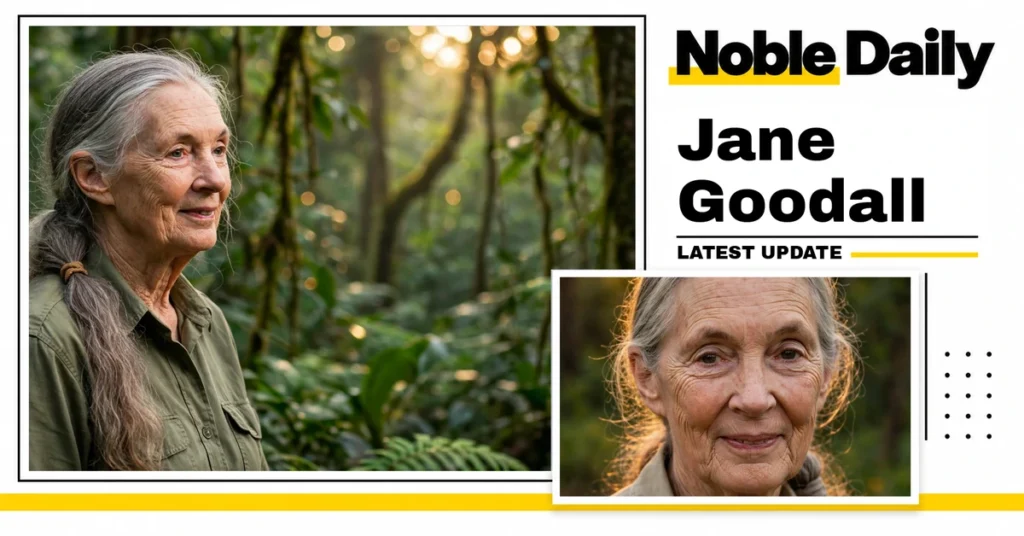
Jane Goodall was a British ethologist and conservationist whose decades-long study of wild chimpanzees in Tanzania transformed animal behavior research. Born in 1934, she became known for documenting chimpanzee toolmaking, family bonds, and social lives.
She died in 2025 at age 91, leaving a global conservation movement through the Jane Goodall Institute and Roots & Shoots.
Who Is Jane Goodall?
Jane Goodall was a pioneering scientist, author, and conservationist best known for studying wild chimpanzees at Gombe in what is now Tanzania. Her research challenged the idea that toolmaking and complex social behavior were uniquely human. Later, she used her public profile to promote wildlife protection, community-led conservation, and youth action.
| Full name | Valerie Jane Morris-Goodall |
| Born | April 3, 1934, in London, England |
| Died | October 1, 2025, in Los Angeles, California |
| Age at death | 91 years old |
| Nationality | British |
| Fields | Ethology, primatology, conservation, animal welfare |
| Education | PhD in ethology, University of Cambridge, 1966 |
| Best known for | Long-term study of wild chimpanzees at Gombe |
| First husband | Hugo van Lawick, married in 1964 |
| Second husband | Derek Bryceson, married in 1975 |
| Child | One son, Hugo Eric Louis van Lawick, known as Grub |
| Founded | Jane Goodall Institute in 1977 and Roots & Shoots in 1991 |
| Major honors | UN Messenger of Peace, Dame Commander of the Order of the British Empire, Presidential Medal of Freedom |
How Old Was Jane Goodall When She Died?
Jane Goodall was 91 years old when she died on October 1, 2025. She was born on April 3, 1934, so her 91st birthday had already passed that year. Her age at death is therefore 91, not 90 or 92.
When Did Jane Goodall Die, and What Was the Cause?
Jane Goodall died on October 1, 2025, in Los Angeles, California, while traveling in the United States for a speaking tour. The Jane Goodall Institute said she died peacefully in her sleep of natural causes. Some later media reports described heart failure, but the Institute’s initial announcement did not provide a detailed medical report.
What Was Jane Goodall’s Childhood Like?
Goodall was born Valerie Jane Morris-Goodall in London to Mortimer Herbert Morris-Goodall, a businessman and racing car driver, and Margaret Myfanwe Joseph, known as Vanne. During her childhood, she moved with her mother and younger sister, Judy, to Bournemouth, where she grew up surrounded by books and animals.
Her father gave her a stuffed chimpanzee named Jubilee when she was about one, and she kept it for much of her life. Reading stories about Africa and animals helped shape her dream of studying wildlife there, even though her family could not afford university tuition.
How Did Jane Goodall’s Education Lead to Cambridge?
Goodall earned a PhD in ethology, the scientific study of animal behavior, from the University of Cambridge in 1966, despite entering doctoral study without an undergraduate degree. After school, she attended secretarial school and worked several jobs to save money for travel.
She did not follow a typical academic path, but her field observations later became the basis of serious scientific work.
Goodall met paleoanthropologist Louis Leakey in Kenya in 1957. He hired her for natural history work and later selected her to study wild chimpanzees, believing that her fresh perspective could be valuable. She began doctoral study at Cambridge in 1962 while continuing to return to Gombe.
How Did Jane Goodall Begin Her Research at Gombe?
Goodall began her landmark chimpanzee study on July 14, 1960, when she arrived at Gombe Stream on the eastern shore of Lake Tanganyika in what is now Tanzania. She was 26 years old and initially accompanied by her mother, Vanne, during her first months in the field.
The work started as a small research project but grew into a study that continued for decades.
National Geographic helped bring the research to a wider audience, and photographer Hugo van Lawick documented Goodall and the chimpanzees. She learned to recognize individuals and record their changing relationships over time. The Gombe project remains active and is one of the world’s longest-running studies of wild chimpanzees.
What Did Jane Goodall Discover About Chimpanzees?
Goodall showed that wild chimpanzees make and use tools, hunt and eat meat, and maintain complex social relationships. One of her most famous observations involved a chimpanzee using a grass stem or twig to draw termites from a mound.
At the time, toolmaking was often treated as a defining human trait, so the finding changed scientific discussion about the boundary between humans and other animals.
Goodall also challenged the idea that animal behavior could be understood without considering individual differences. By naming chimpanzees and recording their temperaments, family bonds, aggression, cooperation, and grief, she helped readers see them as individuals. Some scientists initially criticized this approach.
Several key findings helped shape her lasting influence:
- Chimpanzees can modify objects and use them as tools to obtain food.
- They hunt and eat meat as well as plant foods.
- Mothers and offspring form strong bonds, and social learning shapes behavior.
- Chimpanzee communities show cooperation, conflict, and individual personalities.
Why Were David Greybeard and Flo Important to Her Work?
David Greybeard was one of the first chimpanzees to tolerate Goodall’s presence and was the individual she observed using grass stems to fish for termites. His growing trust helped her observe other members of the community. The name also reflected her choice to recognize chimpanzees as individuals rather than anonymous research subjects.
Flo, a female chimpanzee and matriarch at Gombe, helped Goodall understand family life and mother-infant relationships. Goodall followed Flo and her offspring over time, including Flint, whose strong dependence on his mother became part of her observations of chimpanzee development and grief. These long-term records offered details that short visits could not capture.
Who Was Jane Goodall’s Son?
Goodall had one child, Hugo Eric Louis van Lawick, born in 1967 and nicknamed Grub. His father was Hugo van Lawick, the wildlife photographer who documented Goodall’s work for National Geographic.
Grub spent part of his early life near the research site, but he later lived with his grandmother in England and attended school in Bournemouth.
Goodall balanced parenthood with demanding fieldwork, books, films, and growing public attention.
Who Were Jane Goodall’s Husbands?
Goodall married wildlife photographer Hugo van Lawick in 1964, and the couple divorced in 1974. Their shared work in Tanzania brought them together, but their professional lives eventually took them in different directions. Van Lawick died in 2002.
In 1975, Goodall married Derek Bryceson, a Tanzanian government official who had worked in national parks. Their marriage lasted until his death from cancer in 1980. Goodall did not remarry after Bryceson’s death.
Which Books Did Jane Goodall Write?
Goodall wrote more than two dozen books for adults and children, combining scientific observation, memoir, and conservation advice. Her writing made field research accessible to readers who might never study animal behavior themselves. Some of her best-known titles include:
- In the Shadow of Man (1971), an account of her early years studying chimpanzees.
- The Chimpanzees of Gombe: Patterns of Behavior (1986), a detailed scientific study of chimpanzee behavior.
- Through a Window (1990), which shares later observations from Gombe.
- Reason for Hope: A Spiritual Journey (1999), a memoir about her life and beliefs.
- The Book of Hope: A Survival Guide for Trying Times (2021), written with Douglas Abrams.
How Did the Jane Goodall Institute and Roots & Shoots Carry On Her Work?
Goodall founded the Jane Goodall Institute in 1977 to support chimpanzee research, wildlife protection, and community-led conservation. The organization continues research at Gombe and supports habitat protection, forest restoration, and rescued chimpanzees.
In 1991, she launched Roots & Shoots with young people in Tanzania. The program helps young people design projects for their communities, animals, and the environment. It has since spread across dozens of countries and remains a major part of her legacy.
What Awards and Honors Did Jane Goodall Receive?
Goodall received major honors for both her scientific discoveries and her work to protect the natural world. Among the most notable were:
- The Kyoto Prize in Basic Sciences in 1990 for her long-term chimpanzee research.
- Appointment as a United Nations Messenger of Peace in 2002.
- Recognition as a Dame Commander of the Order of the British Empire, with the honor formally conferred in 2004.
- The Templeton Prize in 2021 for her work connecting science, spirituality, and humanity’s place in nature.
- The United States Presidential Medal of Freedom in 2025.
The honors reflected a career that moved beyond academic research into public education, animal welfare, and environmental advocacy. Goodall became one of the most widely recognized voices for conservation and inspired generations of scientists and young activists.
What Is Known About Jane Goodall’s Net Worth?
No reliable, publicly verified figure establishes Goodall’s personal net worth. Online estimates vary and rarely point to audited disclosures or clear primary sources. Book sales, speaking work, awards, and charitable activity do not establish private wealth, so an exact dollar amount should not be treated as fact.
What Did Jane Goodall Believe About Spirituality?
Goodall explored spirituality and hope in her memoir Reason for Hope: A Spiritual Journey. Her writing described a sense of connection with nature and the value of human choices. The public record does not support reducing her beliefs to a simple atheist label.
Which Films and Documentaries Feature Jane Goodall?
Goodall’s life and research appear in many documentaries and educational films. Jane (2017) used archival footage to tell the story of her early work at Gombe, while Jane Goodall: The Hope (2020) followed her conservation mission. National Geographic also helped introduce her research to global audiences.
What Was Jane Goodall’s Last Interview?
No single interview can be named her last with complete certainty, but one of Goodall’s final recorded conversations was made for the Wall Street Journal’s Journal podcast in September 2025. Netflix also released her reflective Famous Last Words interview after her death.
Since several conversations were recorded close to the end of her life, it is more accurate to describe these as among her final interviews.
How Was Jane Goodall Remembered After Her Death?
Goodall was honored at a funeral and celebration of life service at Washington National Cathedral on November 12, 2025. More than 1,500 people gathered, with tributes from her family, scientist Francis Collins, and actor and environmentalist Leonardo DiCaprio. Her ashes were present at the ceremony.
Her death prompted tributes from scientific organizations, conservation groups, public figures, and people inspired by her work. The Institute’s public announcements document the Washington service but do not name a separate permanent burial location.
Beyond her own fieldwork, Jane Goodall’s legacy is often discussed alongside the other pioneering primatologists whose stories are covered here: Dian Fossey, Biruté Galdikas, Frans de Waal, and Robert Sapolsky.
Conclusion
Jane Goodall’s legacy extends beyond one discovery. Her chimpanzee research changed science, while her conservation work connected research with community action and youth leadership. Through her institute, Roots & Shoots, and books, she left a lasting call to protect the natural world.