Biruté Galdikas
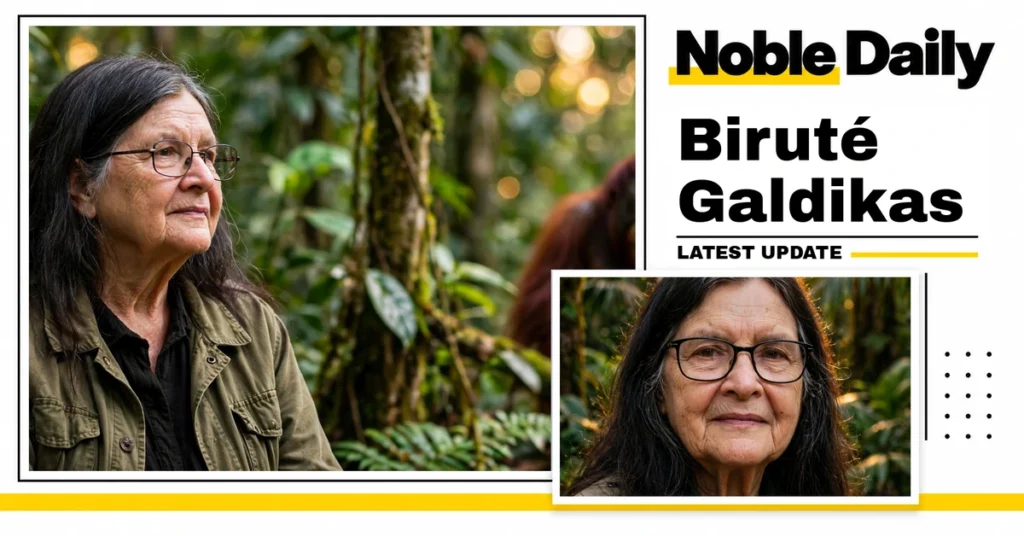
Biruté Galdikas was a Canadian primatologist and conservationist best known for her decades of research on wild orangutans in Indonesian Borneo. As one of Louis Leakey’s “Trimates,” alongside Jane Goodall and Dian Fossey, she changed how scientists understood orangutan behavior and helped build major efforts to rescue the endangered apes and protect their rainforest home.
Who Is Biruté Galdikas?
Biruté Galdikas was a pioneering field scientist whose work connected long term animal research with practical conservation. She began studying orangutans at Camp Leakey in 1971 and spent more than five decades documenting their behavior while working to protect the forests they need.
| Full name | Dr. Biruté Mary Galdikas |
| Born | May 10, 1946, in Wiesbaden, Germany |
| Died | March 24, 2026, in Los Angeles, California |
| Age at death | 79 |
| Known for | Long term orangutan research and rainforest conservation |
| Education | Bachelor’s degrees in psychology and zoology in 1966, a master’s in anthropology in 1969, and a doctorate in anthropology in 1978 |
| Field site | Camp Leakey, Tanjung Puting, Indonesian Borneo |
| Organization | Orangutan Foundation International, founded in 1986 |
| Spouses | Rod Brindamour and Pak Bohap |
| Children | Binti Brindamour, Frederick Bohap Galdikas, and Jane Filomena Galdikas |
How Did Biruté Galdikas’s Childhood Shape Her Interest in Nature?
Her early curiosity about animals and exploration helped shape the career that later took her into Borneo’s rainforest.
Born on May 10, 1946, in Wiesbaden, Germany, Galdikas was the daughter of Lithuanian parents who later moved their family to Canada.
She grew up in Toronto, where she developed an interest in animals, human origins, and the natural world.
One small childhood memory became part of her story. At about six years old, she borrowed a Curious George book from the library, and by second grade she had decided that she wanted to become an explorer. That ambition eventually led her from classrooms to one of the most difficult field environments in primate research.
Galdikas studied at the University of British Columbia before continuing at the University of California, Los Angeles. She earned bachelor’s degrees in psychology and zoology in 1966, a master’s degree in anthropology in 1969, and a doctorate in anthropology in 1978. Her training gave her a strong foundation for studying animal behavior in the wild.
How Did Louis Leakey Help Launch Her Orangutan Research?
Paleoanthropologist Louis Leakey helped make Galdikas’s plan to study wild orangutans possible by securing support for her fieldwork. She met him while she was a graduate student at UCLA and explained her goal of observing orangutans in their natural habitat. After years of persistence, she received the support needed to begin her research in Indonesia.
In 1971, Galdikas traveled to Indonesian Borneo with her then husband, photographer Rod Brindamour.
She was 25 and entered a remote forest landscape where roads, electricity, phones, and regular mail service were largely absent.
Her work became part of a larger effort encouraged by Leakey, who had also supported Jane Goodall’s chimpanzee research and Dian Fossey’s work with mountain gorillas.
What Made Camp Leakey Important?
Camp Leakey became the base for Galdikas’s long term study of Bornean orangutans in what is now Tanjung Puting National Park in Central Kalimantan, Indonesia. She named the camp in honor of Louis Leakey, her mentor and an early supporter of her work.
The setting was demanding. Rain often flooded the swamps, and researchers had to move through thick forest while dealing with leeches, insects, mud, and dangerous wildlife. Rather than relying on short visits, Galdikas followed individual orangutans over many years. This patient method helped her recognize patterns that would have been missed in brief observations.
Her research at Camp Leakey grew into one of the longest continuous field studies of a wild mammal led by a single principal investigator. The work followed orangutans across five generations and gave later scientists a rare long view of how individual animals and their forest environment changed over time.
What Did Biruté Galdikas Discover About Orangutans?
Galdikas’s observations expanded scientific knowledge of orangutan diets, reproduction, nesting, daily activity, and social behavior. She documented how orangutans relied heavily on fruit while also eating other foods, which showed that they were not strict vegetarians.
Her fieldwork also helped establish how slowly orangutans reproduce. Females commonly have young at intervals of about six to eight years, while mothers invest heavily in caring for their offspring. That long period of care is one reason orangutan populations recover slowly after losses from hunting, capture, or habitat destruction.
Galdikas’s research helped replace the idea that orangutans were simply solitary animals with a more detailed picture of their lives.
Although many spend long periods alone while feeding, their behavior includes social contact, complex mother and infant bonds, and patterns that vary with age and sex.
Her work gave researchers a stronger basis for understanding the needs of this endangered great ape.
How Did She Turn Research Into Orangutan Conservation?
Galdikas built a conservation program around the idea that protecting orangutans also meant protecting their rainforest and helping animals harmed by human activity. She helped establish long term rehabilitation work for orphaned orangutans, including animals taken from the wild or kept illegally as pets.
In 1986, she founded Orangutan Foundation International, which supported research, rescue, rehabilitation, release, and forest protection. The organization reports that its work has contributed to the release of more than 1,000 rehabilitated orangutans and the rescue or relocation of about 200 wild orangutans.
Galdikas also worked with Indonesian partners to protect Tanjung Puting, which became a national park, and she organized the first Great Apes of the World Conference in 1991.
Her work brought greater attention to threats such as logging, palm oil expansion, habitat loss, and the illegal wildlife trade.
She faced serious risks during this work, including threats and a kidnapping, and she also experienced a dangerous bout of malaria.
Her hands on rehabilitation methods were not free from debate.
Some researchers questioned whether close contact with humans could affect an orangutan’s behavior before release or raise disease risks for wild populations.
Rehabilitation practices changed as scientific knowledge and welfare standards developed.
The debate remains part of the history of early great ape conservation, where rescuing individual animals had to be balanced with protecting wild populations.
Who Were Biruté Galdikas’s Husband and Children?
Galdikas had three children and was married twice. She married photographer Rod Brindamour in 1970, and they traveled together to Borneo for the start of her research. The couple divorced in 1979, and their son was Binti Brindamour.
In 1981, Galdikas married Pak Bohap, a Dayak man from Borneo who had worked at Camp Leakey. They had two children, Frederick Bohap Galdikas and Jane Filomena Galdikas. Pak Bohap died in 2022. At the time of her death, Galdikas was survived by her three children and seven grandchildren.
Her family life was closely linked to the place where she worked. She spent much of her life in Indonesia, learned local languages, and built relationships with communities around Tanjung Puting. Those connections mattered to her conservation work because long term protection depended on local knowledge, cooperation, and livelihoods as well as scientific research.
When Did Biruté Galdikas Die, and What Was Her Cause of Death?
Biruté Galdikas died in Los Angeles, California, on March 24, 2026, at age 79, after battling lung cancer and pulmonary fibrosis. She was born on May 10, 1946, and died about seven weeks before her 80th birthday.
Orangutan Foundation International reported that the illnesses may have been worsened by her efforts to combat wildfires that threatened orangutan habitat in Borneo.
The organization described that connection as likely, so it should not be presented as a proven medical cause.
Her death was mourned by colleagues, students, and conservation groups that viewed her as a leading figure in modern primatology.
What Awards and Books Mark Her Legacy?
Galdikas’s career was recognized through major environmental awards, university teaching, scientific publications, and books for general readers. Her memoir, Reflections of Eden, published in 1995, described her years living and working with orangutans in Borneo.
Among her notable honors were:
- Officer of the Order of Canada in 1995.
- The Tyler Prize for Environmental Achievement in 1997.
- Indonesia’s Kalpataru Award for environmental leadership in 1997.
- The Explorers Club Medal in 2025 for her contributions to science and exploration.
She also taught at Simon Fraser University in Canada for more than four decades and held an academic role at Universitas Nasional in Jakarta. Her work reached a wider audience through documentaries, including Born to Be Wild, and through decades of reporting and photography that made orangutans familiar to people far from the rainforest.
Is Biruté Galdikas’s Net Worth Publicly Known?
No reliable public source establishes a verified net worth for Biruté Galdikas. Her career centered on field research, university teaching, writing, and nonprofit conservation rather than entertainment or a publicly traded business.
Precise figures sometimes repeated online should not be treated as facts unless they are supported by trustworthy financial records. Her documented legacy is better measured through the research she made possible, the students she taught, the orangutans her teams helped, and the forests she worked to protect.
Biruté Galdikas’s story is often told alongside the other pioneering primatologists whose lives are covered here: Jane Goodall, Dian Fossey, Frans de Waal, and Robert Sapolsky.
Conclusion
Biruté Galdikas changed the study of orangutans by committing decades to observing them in the wild. Her research clarified how they feed, reproduce, and live in forest ecosystems, while her conservation work helped rescue animals and protect their habitat.
She died at age 79 in 2026, but the work she began at Camp Leakey continues through researchers, local conservation teams, and Orangutan Foundation International. Her life remains a powerful example of how careful science and sustained action can support the survival of an endangered species.