Roger Penrose Biography | Age, Nobel Prize & Theories
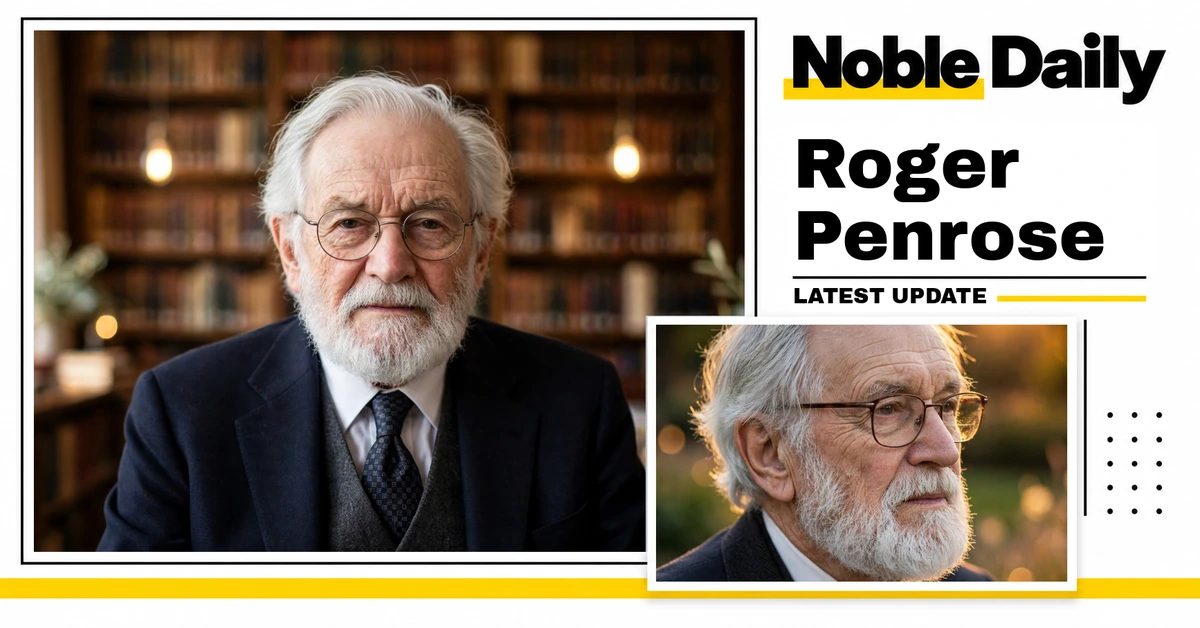
Sir Roger Penrose is a British mathematician and mathematical physicist best known for proving that black holes are a natural result of Einstein’s theory of general relativity. He won half of the 2020 Nobel Prize in Physics and has also shaped research on geometry, cosmology, and consciousness. Penrose is 95 years old as of 2026.
Who Is Roger Penrose?
Roger Penrose is a mathematician, theoretical physicist, and philosopher of science whose research has changed how scientists understand black holes, space, and time. His work connects complex mathematical ideas with some of the universe’s biggest questions, including how black holes form, how the universe began, and whether science can fully explain human consciousness.
| Full name | Roger Penrose |
| Known as | Sir Roger Penrose |
| Date of birth | August 8, 1931 |
| Age | 95 years old as of 2026 |
| Birthplace | Colchester, Essex, England |
| Nationality | British |
| Profession | Mathematician, mathematical physicist, author |
| Education | University College London and University of Cambridge |
| Academic position | Emeritus Rouse Ball Professor of Mathematics at the University of Oxford |
| Wife | Vanessa Dee Thomas |
| Children | Four sons |
| Nobel Prize | Nobel Prize in Physics, 2020 |
| Main research areas | General relativity, cosmology, geometry, and consciousness |
| Known for | Black hole research, twistor theory, Penrose tiling, and cosmology |
How Old Is Roger Penrose?
Roger Penrose was born on August 8, 1931, making him 95 years old as of 2026. His birthday had already passed by the article’s publication date of October 29, 2026.
Penrose has spent decades studying the mathematical laws that govern the universe. His scientific career has included university teaching, groundbreaking research, and books that explain complex ideas to readers outside the scientific community.
What Was Roger Penrose’s Childhood Like?
Roger Penrose grew up in a family that valued mathematics, science, puzzles, and creative thinking. His father, Lionel Sharples Penrose, was a medical geneticist, while his mother, Margaret Leathes, had studied medicine.
Penrose developed an early interest in geometry. He enjoyed making geometric shapes and exploring mathematical patterns with his father and older brother, Oliver Penrose, who later became a respected physicist and mathematician.
Where Did Roger Penrose Study?
Roger Penrose studied mathematics at University College London and completed his doctoral studies at the University of Cambridge. He earned a first class degree in mathematics from University College London in 1952.
He then attended St John’s College, Cambridge, where he researched algebraic geometry. He received his PhD in 1957 under the supervision of mathematician John Todd, after initially working with William Hodge.
Although his doctoral research focused on pure mathematics, Penrose was becoming increasingly interested in physics. This combination of mathematical skill and interest in the physical universe later became a defining feature of his work.
Who Is Roger Penrose’s Wife and How Many Children Does He Have?
Roger Penrose has been married twice and has four sons. His first wife was Joan Isabel Wedge, whom he married in the late 1950s. His second wife is Vanessa Dee Thomas, whom he married in 1988.
Biographical sources differ on whether his first marriage took place in 1958 or 1959. They agree that the marriage ended in divorce in 1980. Penrose and his family have generally maintained a private life despite his international reputation.
His four sons are:
- Christopher Shaun Penrose
- Toby Nicholas Penrose
- Eric Alexander Penrose
- Maxwell Sebastian Penrose
The first three sons were born during his first marriage, while Maxwell was born in 2000 during his second marriage.
What Did Roger Penrose Win the Nobel Prize For?
Roger Penrose received half of the 2020 Nobel Prize in Physics for demonstrating that black hole formation is a robust prediction of Einstein’s general theory of relativity.
The other half of the prize was shared by Reinhard Genzel and Andrea Ghez for their discovery of a supermassive compact object at the center of the Milky Way.
Penrose’s award recognized theoretical work that helped establish black holes as a natural consequence of gravitational collapse. His research showed that black hole formation does not depend on an unrealistically perfect spherical shape, making the result important for understanding the behavior of real stars and spacetime.
What Books Did Roger Penrose Write?
Roger Penrose has written several influential books about mathematics, physics, cosmology, and consciousness. His writing brings difficult scientific questions to a wider audience while also presenting arguments that remain subjects of debate.
Some of his best known books include:
- The Emperor’s New Mind (1989), which examines the relationship between physics, computers, and human thought.
- Shadows of the Mind, which develops his arguments about consciousness and the limits of artificial intelligence.
- The Road to Reality (2004), a broad and detailed guide to the mathematical foundations of modern physics.
- Cycles of Time (2010), which explains his ideas about the universe and its possible cosmic history.
- Fashion, Faith, and Fantasy in the New Physics of the Universe (2016), which examines major questions and assumptions in modern physics.
Penrose also coauthored The Nature of Space and Time with Stephen Hawking. His books show that his interests extend beyond black holes to the deeper questions behind physical reality and human understanding.
What Are Roger Penrose’s Religious Beliefs?
Roger Penrose has expressed doubts about conventional religious beliefs, but his public comments have used different labels for his position. In one interview, he described himself as an atheist because he did not believe in any religion he had encountered. Another interview characterized his views as agnostic.
His more consistent position is that questions about consciousness, existence, and the nature of reality deserve serious investigation. He has argued that science does not yet fully explain consciousness, while continuing to explore whether new physical theories could help address the problem.
How Did Roger Penrose and Stephen Hawking Work Together?
Roger Penrose and Stephen Hawking helped establish that singularities are a general prediction of general relativity under certain physical conditions. Their research connected the mathematics of black holes with the question of how the universe began.
Penrose developed a theorem showing that gravitational collapse can lead to a singularity. Hawking adapted related mathematical methods to cosmology and investigated singularities associated with the Big Bang. They later collaborated on a broader result that brought their approaches together.
Their work became a major part of modern gravitational physics. Although Penrose and Hawking approached different questions, their shared research helped scientists understand why singularities matter when studying the most extreme conditions in the universe.
Roger Penrose’s Major Scientific Contributions
Roger Penrose’s most important scientific contributions include his work on black holes, spacetime geometry, mathematical patterns, and the relationship between physics and consciousness. His research has influenced both theoretical physics and pure mathematics.
Black Holes and Gravitational Collapse
Penrose made a major breakthrough in 1965 when he published research showing that a singularity can form during gravitational collapse under general conditions. A singularity is a region where the mathematical description of spacetime breaks down.
Before this work, some scientists questioned whether black holes described by mathematical equations could form in the real universe. Penrose showed that their formation was not simply an artifact of assuming a perfectly spherical object.
His theorem provided a rigorous mathematical foundation for understanding black holes as a natural outcome of general relativity. The Nobel Committee later recognized this contribution as the central reason for his 2020 award.
Twistor Theory and the Geometry of Spacetime
Penrose developed twistor theory as a mathematical approach to studying spacetime and exploring connections between relativity and quantum theory. The framework uses geometric and algebraic ideas to investigate the structure of physical reality.
His work also helped researchers visualize the structure of spacetime through mathematical diagrams. These methods offer ways to study how light, particles, and gravitational effects behave within the framework of relativity.
Although a complete unification of gravity and quantum mechanics remains an open problem, Penrose’s mathematical ideas continue to influence theoretical research.
Penrose Tiling and Mathematical Patterns
Penrose also made important contributions to geometry through a type of tiling that can cover a surface without repeating the same pattern periodically. Known as Penrose tiling, this system uses a small set of shapes to produce complex patterns.
Unlike ordinary repeating tiles, Penrose patterns can display order without forming a regular repeating grid. The idea became especially significant after researchers discovered related forms of nonperiodic order in quasicrystals.
His work in this area demonstrates how abstract mathematical patterns can connect with physical structures. It also shows that his achievements extend well beyond the study of black holes.
The Cosmic Censorship Hypothesis
Penrose proposed the cosmic censorship hypothesis to address a difficult question about singularities. In simple terms, the idea suggests that the most problematic singularities produced by gravitational collapse may be hidden from distant observers by event horizons.
An event horizon is the boundary around a black hole beyond which light cannot escape to the outside universe. If cosmic censorship holds under the relevant conditions, it would help preserve the ability of scientists to describe the wider universe using established physical laws.
The hypothesis remains an important research question rather than a fully proven rule for every possible situation. Its significance lies in the attempt to understand where general relativity works and where its mathematical limits become important.
What Is Roger Penrose’s Theory of a Cyclical Universe?
Roger Penrose’s conformal cyclic cosmology, often called CCC, proposes that the universe may pass through an endless sequence of cosmic eras rather than having only one beginning.
Penrose calls each era an aeon. In his model, the distant future of one aeon can connect mathematically with the Big Bang of the next. He argues that the extreme expansion of the universe changes the importance of physical scale, allowing these two stages to be linked through conformal geometry.
This idea offers a different way to think about the Big Bang. In the standard cosmological model, the universe expanded from an early hot, dense state. Penrose’s proposal goes further by suggesting that this beginning may connect to the remote future of an earlier cosmic era.
However, CCC is not an established replacement for the standard cosmological model. Penrose and his collaborators have proposed possible observational signals in the cosmic microwave background, the ancient radiation left over from the early universe. Other researchers have questioned whether the reported patterns provide convincing evidence for the theory.
The proposal remains an active subject of scientific discussion. It is important to distinguish Penrose’s creative theoretical work from a confirmed description of the universe’s history.
Roger Penrose’s Awards and Recognition
Roger Penrose has received major scientific honors for his work in mathematics, theoretical physics, and cosmology. His awards recognize decades of research into gravity, spacetime, and the mathematical structure of the universe.
Some of his most important honors include:
- 1972: Elected a Fellow of the Royal Society, one of the United Kingdom’s leading scientific institutions.
- 1988: Shared the Wolf Prize in Physics with Stephen Hawking for their contributions to general relativity and the study of singularities.
- 1994 and 2000: Knighted for services to science in 1994 and appointed to the Order of Merit in 2000.
- 2008: Received the Copley Medal from the Royal Society for his exceptional contributions to geometry and mathematical physics.
- 2020: Awarded half of the Nobel Prize in Physics for showing that black hole formation is a robust prediction of general relativity.
Penrose has also received the Royal Medal, the Eddington Medal, the Dirac Medal, the Albert Einstein Medal, and the De Morgan Medal. These honors reflect the breadth of his influence across mathematics and physics.
To finish this set of physicist biographies, explore the stories of Stephen Hawking, Albert Einstein, Isaac Newton, Michael Faraday, James Clerk Maxwell, Max Planck, Niels Bohr, Werner Heisenberg, Erwin Schrödinger, and Paul Dirac.
Conclusion
Roger Penrose’s legacy rests on his ability to use mathematics to explore some of the deepest questions about the universe. His work helped establish black hole formation as a prediction of general relativity, while his research on geometry, cosmology, and consciousness opened new paths for scientific debate.
His 2020 Nobel Prize recognized a discovery that changed the understanding of black holes. Beyond that achievement, his books and theories continue to encourage scientists and readers to question how the universe works and what science can reveal about reality.
Penrose remains an important figure in modern mathematical physics, with a career that connects abstract ideas to fundamental questions about space, time, and human thought.