Carl Jung Biography | Theories, Books & Lasting Legacy
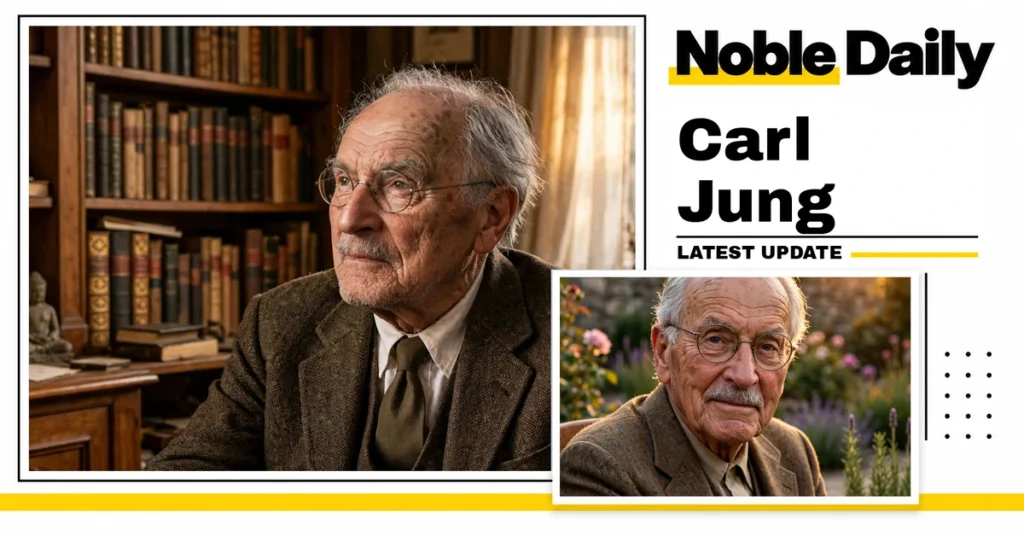
Carl Gustav Jung was a Swiss psychiatrist who founded analytical psychology and changed how many people think about dreams, personality, symbols, and the unconscious. First known as a close colleague of Sigmund Freud, he later built a distinct school of thought that continues to shape psychotherapy, literature, religion, and popular culture.
Who Is Carl Jung?
Carl Jung was a Swiss psychiatrist and the founder of analytical psychology, a field that explores the conscious mind alongside personal and shared unconscious patterns. His work brought psychology into closer contact with mythology, religion, art, and the study of personality.
| Full name | Carl Gustav Jung |
| Born | July 26, 1875, in Kesswil, Switzerland |
| Died | June 6, 1961, in Küsnacht, Switzerland |
| Age at death | 85 |
| Nationality | Swiss |
| Profession | Psychiatrist and writer |
| Known for | Analytical psychology, archetypes, the collective unconscious, and psychological types |
| Wife | Emma Rauschenbach, married in 1903 |
| Children | Five |
What Were Carl Jung’s Early Life and Education?
Jung was born on July 26, 1875, in Kesswil, a village near Lake Constance in northern Switzerland. His father, Paul Jung, was a Swiss Reformed pastor, and his mother, Emilie Preiswerk, came from a family with several ministers. Religious life, family tensions, dreams, and private questions about belief shaped his early interests.
He entered the University of Basel in 1895 and completed his medical studies in 1900. He chose psychiatry at a time when many doctors gave the field little respect.
The Library of Congress biography exhibition records that he began work at the Burghölzli psychiatric hospital in Zurich in 1900 and received his medical doctorate in 1902.
How Did Jung Build His Psychiatric Career?
Jung built his early reputation through clinical work and research at Burghölzli, where psychiatrist Eugen Bleuler directed the hospital. Jung used word-association tests to study emotional reactions and helped develop the idea of psychological complexes, groups of emotionally charged thoughts and memories that can influence behavior.
His career later included teaching and private practice. The ETH Zurich archival profile records his work at the University of Zurich from 1905 to 1913, teaching at ETH Zurich from 1933 to 1941, and a professorship at the University of Basel in 1944.
The ETH Library now holds a major archive of his manuscripts and correspondence.
Several milestones show how his work moved from hospital research to a wider school of psychology:
- 1900: Began psychiatric work at Burghölzli in Zurich.
- 1905: Started teaching at the University of Zurich.
- 1921: Published Psychological Types.
- 1933: Took the presidency of an international psychotherapy society.
- 1955: Received an honorary doctorate from ETH Zurich.
Who Was Carl Jung’s Wife and How Many Children Did He Have?
Jung married Emma Rauschenbach in 1903, and they had five children. The family moved to a home they built in Küsnacht, near Zurich, in 1909. Emma took an active interest in psychology, became an analyst herself, and spent years studying the legends of the Holy Grail.
Emma came from a wealthy Swiss industrial family, and her inheritance gave Jung greater financial freedom to pursue research and writing. She died in 1955, six years before her husband.
The Library of Congress account of the Jung family documents her role in his life and work, rather than presenting her only as a supporting figure.
Why Did Carl Jung and Sigmund Freud End Their Relationship?
Jung and Freud were close collaborators from 1907 to 1912, but their friendship and professional partnership broke apart in 1913. Jung believed Freud placed too much weight on sexuality when explaining the mind. Jung wanted a broader account that included myths, religion, symbols, and forms of unconscious experience.
The disagreement was both personal and intellectual. Freud saw Jung as a possible leader of psychoanalysis, while Jung increasingly rejected parts of Freud’s theory. After the split, Jung developed his own approach instead of continuing as a senior figure in Freud’s movement.
What Is Analytical Psychology?
Analytical psychology is Jung’s approach to understanding the whole person through conscious thought, personal experience, and unconscious processes. It differs from Freud’s psychoanalysis by giving greater attention to symbols, cultural stories, spiritual questions, and the possibility of psychological growth across adult life.
Jung believed the unconscious was not only a storehouse of forgotten or repressed memories. He argued that it could also produce images and ideas that help a person face new stages of life.
His approach became influential in psychotherapy and in the study of literature, religion, and the arts, although not all of his theoretical claims are accepted as established science.
What Did Jung Mean by Archetypes and the Collective Unconscious?
Jung used the term collective unconscious for a deeper layer of the psyche that he believed humans share. He proposed that it contains archetypes, recurring patterns that appear in dreams, myths, stories, religious images, and art. These are central ideas in Jungian psychology, but they remain theoretical concepts rather than proven biological structures.
Jung described several familiar archetypal patterns and parts of the personality. In his model, the persona is the social face a person presents to the world, while the shadow holds traits that a person may deny or avoid.
He used anima and animus for inner figures he described through the gender assumptions of his era. Modern readers and clinicians often question those fixed gender divisions.
Jung called the long process of bringing conscious and unconscious parts of the personality into a more balanced whole individuation. It did not mean becoming perfect or isolated. It meant recognizing more of oneself and taking responsibility for traits that might otherwise remain hidden.
Why Did Jung Study Introversion and Extraversion?
Jung described introversion and extraversion as two broad ways people direct their attention and psychological energy. He presented the theory in Psychological Types, published in 1921.
In his account, introversion turns more toward inner ideas and reflection, while extraversion gives more attention to the outside world and its people or events. The original text of Psychological Types shows how Jung defined these orientations.
These terms later became part of everyday language. Katharine Cook Briggs and Isabel Briggs Myers drew on Jung’s ideas when they developed the Myers-Briggs Type Indicator, first published in 1962. Their test added its own framework, so it should not be treated as a test Jung created himself.
The Library of Congress overview of Jung’s cultural influence explains this connection.
How Did Jung Interpret Dreams, Mandalas, Alchemy, and Synchronicity?
Jung viewed dreams as meaningful expressions of the psyche, not simply as disguised wishes or random images. He studied symbols from different cultures and explored how mandalas, circular designs often linked with wholeness, appeared in art and personal experience. He also read alchemical texts as symbolic accounts of inner change.
His idea of synchronicity described coincidences that feel meaningfully connected even when no direct cause links them. Jung explored this idea with physicist Wolfgang Pauli. Synchronicity remains an influential part of Jungian thought, but it is not a scientific law that proves coincidences have a hidden cause.
Which Carl Jung Books Are Most Important?
Jung published books and essays on psychiatry, personality, religion, symbols, and culture. These works offer a useful starting point for readers exploring his ideas:
- Psychological Types (1921), his major study of personality orientations and psychological functions.
- Modern Man in Search of a Soul (1933), essays on modern life, religion, and psychological questions.
- Psychology and Alchemy (1944), his study of alchemical images as symbols of psychological processes.
- Aion (1951) and Answer to Job (1952), works on the self, religious symbolism, and the meaning of biblical imagery.
- The Undiscovered Self (1957), a short work on the individual and mass society.
Memories, Dreams, Reflections was published in German in 1962 and in English in 1963. It was shaped with Aniela Jaffé, who recorded and edited Jung’s memories. Man and His Symbols appeared in 1964, after his death, with a chapter by Jung and contributions from close colleagues.
What Is The Red Book and Why Was It Published in 2009?
The Red Book, also known as Liber Novus, is Jung’s illustrated record of his exploration of the unconscious. He developed it from notebooks and personal experiences that began after his break with Freud. He worked on the manuscript from 1914 into the early 1930s, combining handwritten text with elaborate paintings and symbols.
Jung did not publish the book during his lifetime. His heirs later agreed to release it, and a facsimile edition appeared in 2009. The Library of Congress Red Book exhibition explains that the manuscript contains material Jung considered central to the later development of his psychology.
What Was the Bollingen Tower?
The Bollingen Tower was a retreat Jung began building in 1923 on the shore of Lake Zurich. He expanded it in stages, with the final addition made in 1955 after Emma’s death.
Jung used the stone building as a place for quiet work and reflection, and he treated it as a physical expression of his inner life. The Library of Congress account of Bollingen describes the tower’s construction and meaning.
Was Carl Jung Connected to Nazism?
Jung’s record during the rise of Nazism is controversial and cannot be reduced to a simple yes or no. In 1933, he accepted the presidency of the General Medical Society for Psychotherapy and became involved with its publication.
During this period, he also made public statements that drew distinctions between Jewish and so-called Aryan psychology, language that scholars have criticized as anti-Semitic.
Historical interpretations differ on the meaning of his institutional actions. Ann C. Lammers’s 2012 historical study, based partly on unpublished documents, argues that Jung tried to keep the society international and politically neutral and worked to help German Jewish colleagues affected by Nazi laws.
Other scholarship, including Stephen Frosh’s study, stresses his anti-Semitic statements and his willingness to work within institutions reshaped under Nazi rule. Both the statements and the attempts to assist colleagues belong in a fair account of the period.
What Was Carl Jung’s Net Worth?
There is no reliable public record that establishes Jung’s net worth, so a specific dollar figure would be guesswork. The Library of Congress notes that Emma’s inheritance gave the family financial security and allowed Jung to focus on his clinical work, research, and writing.
That context is documented, but it does not provide a verified personal wealth total.
How Old Was Carl Jung When He Died, and What Was His Cause of Death?
Jung was 85 when he died on June 6, 1961, at his home in Küsnacht, Switzerland. He was born on July 26, 1875, so he died before his 86th birthday.
ETH Zurich and the International Association for Analytical Psychology confirm the date and place of death, but their biographical records do not name a specific medical cause. It is more accurate to leave the cause unspecified than to repeat an unsupported diagnosis.
Psychology’s founders each offered a different lens: explore Sigmund Freud, Alfred Adler, William James, John Watson, Ivan Pavlov, B. F. Skinner, Abraham Maslow, and Carl Rogers for more.
What Is Carl Jung’s Lasting Legacy?
Jung’s lasting legacy is the language and set of questions he brought into modern discussions of personality, dreams, symbols, and the unconscious. His ideas influenced psychotherapy, the arts, religious studies, and later personality frameworks.
His work also remains debated because some of his theories lack strong scientific support and parts of his public record deserve criticism.
Readers often encounter Jung through terms such as archetype, shadow, introversion, and synchronicity before they read his books. The best way to understand his influence is to study both sides of his record: the concepts that opened new paths for exploring human experience and the historical limits and prejudices that modern readers must examine.