Isaac Newton | Biography, Discoveries, and Scientific Legacy
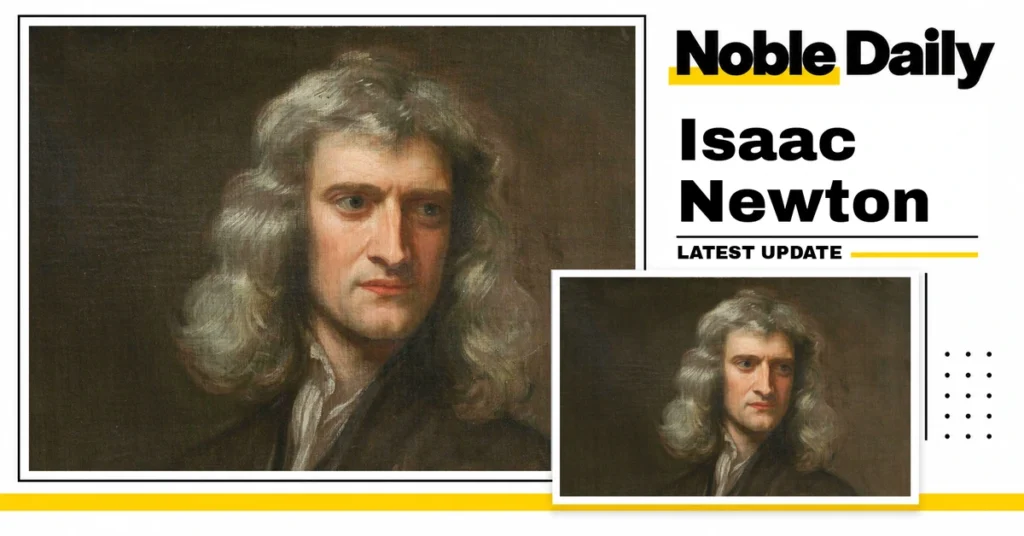
Isaac Newton was an English mathematician, physicist, and astronomer whose work transformed how people explain motion, gravity, light, and the universe. Best known for the laws of motion and universal gravitation, he also helped develop calculus, built a practical reflecting telescope, and later led the Royal Mint and the Royal Society.
Who Is Isaac Newton?
Sir Isaac Newton was a leading figure in the Scientific Revolution whose ideas helped shape modern physics and mathematics. His work connected falling objects on Earth with the motion of planets, while his experiments with light and mathematical methods changed scientific study for generations.
| Full name | Sir Isaac Newton |
| Born | 4 January 1643 in the Gregorian calendar, also recorded as 25 December 1642 in the Julian calendar |
| Birthplace | Woolsthorpe Manor, Lincolnshire, England |
| Died | 31 March 1727 in the Gregorian calendar, also recorded as 20 March 1726/27 in the English calendar then in use |
| Age at death | 84 years old |
| Known for | Laws of motion, universal gravitation, calculus, optics, and the reflecting telescope |
| Education | King’s School in Grantham and Trinity College, Cambridge |
| Major books | Philosophiæ Naturalis Principia Mathematica (1687) and Opticks (1704) |
| Public roles | President of the Royal Society and Master of the Royal Mint |
| Marriage and children | Never married, with no known children |
| Net worth | No reliable modern net-worth estimate is available |
How Did Newton’s Childhood and Family Shape His Early Life?
Newton was born at Woolsthorpe Manor in Lincolnshire, England. His father, also named Isaac Newton, died before his son was born.
His mother, Hannah Ayscough, remarried Barnabas Smith in 1646 and moved to her new husband’s home, leaving young Isaac in the care of his maternal grandmother, Margery Ayscough.
After Smith died in 1653, Hannah returned to Woolsthorpe with Newton’s three younger half-siblings.
Newton attended the King’s School in Grantham and boarded with a local family.
For a time, his mother took him out of school so he could help manage the family farm, but he showed little interest or skill in that work.
His uncle and schoolmaster encouraged him to return to his studies and prepare for university. The records tell us about these early disruptions, although they cannot fully explain how Newton’s childhood shaped his private character.
Where Did Isaac Newton Study and Teach?
Newton entered Trinity College, Cambridge, in 1661 and earned his bachelor’s degree in 1665. He studied within a university tradition that still relied on older authorities, but he also read newer work in mathematics and natural philosophy. He began to build his own approach through private study, close observation, and mathematical reasoning.
When plague forced Cambridge to close, Newton returned to Woolsthorpe in 1665 and remained away for much of the next two years. During this period, he developed important early ideas in mathematics, optics, and gravity.
He returned to Cambridge in 1667, became a fellow of Trinity, and was appointed Lucasian Professor of Mathematics in 1669.
He held that chair until the turn of the century, although his work at the Mint later drew him to London.
What Did Isaac Newton Discover?
Newton’s greatest contributions formed a connected explanation of motion, gravity, light, and mathematical change rather than one isolated discovery. His best-known achievements include the following.
- He set out the three laws of motion, describing inertia, changes in motion caused by force, and equal and opposite reactions.
- He formulated the theory of universal gravitation, which described the attraction between bodies and linked motion on Earth with motion in space.
- He developed a method of calculus independently of Gottfried Wilhelm Leibniz, giving mathematics new tools for studying change.
- He showed that white light contains a spectrum of colors and built a working reflecting telescope to improve astronomical observation.
His methods helped establish mathematical explanation as a central part of modern science.
How Did Newton Explain Gravity and the Laws of Motion?
Newton’s three laws of motion gave scientists a way to predict how objects move. The first law describes inertia, meaning an object keeps its state of rest or steady motion unless a force changes it.
The second connects a force with a change in motion, and the third states that every action has an equal and opposite reaction.
His law of universal gravitation proposed that every body attracts every other body, with the strength of the attraction depending on their masses and the distance between them.
This helped explain falling objects, planetary orbits, and the paths of comets within one mathematical framework. Einstein’s later theory of general relativity refined our understanding of gravity, but Newton’s equations remain useful in many everyday, engineering, and astronomical calculations.
Why Is Principia Mathematica Considered His Greatest Work?
Newton’s Principia Mathematica was published in July 1687 under the full Latin title Philosophiae Naturalis Principia Mathematica, usually translated as Mathematical Principles of Natural Philosophy. The book set out his laws of motion and theory of gravitation in a detailed mathematical form.
Astronomer Edmond Halley encouraged Newton to complete the work and paid for its publication.
The book showed how the same rules could explain the movement of bodies on Earth and in the heavens, a major step toward a unified picture of nature.
Its mathematics was difficult for many readers, but it became one of the most influential scientific works ever published.
What Did Newton Learn About Light and Optics?
Newton’s experiments showed that white light contains different colors that a prism separates, rather than a prism simply adding color to otherwise pure light. He studied how light refracts, how colors behave, and how lenses and mirrors affect an image.
His book Opticks, published in 1704, presented many of these findings and became a major work in the study of light.
In 1668, Newton built a practical reflecting telescope that used a curved mirror instead of relying only on lenses. This design reduced a color distortion that affected refracting telescopes and helped show the value of mirror-based instruments. The telescope became one of the most visible examples of Newton turning scientific ideas into a working device.
Was the Apple Story About Isaac Newton True?
The apple story has a historical basis, but popular versions often exaggerate what happened. Newton’s friend William Stukeley recorded a conversation in which Newton recalled sitting in a garden and seeing an apple fall, prompting him to think about why objects descend toward the ground.
The account does not say that the apple hit Newton on the head or that he discovered the complete theory of gravity in a sudden moment. He developed the mathematics over many years, and the full theory appeared in the Principia in 1687.
Did Isaac Newton Invent Calculus, or Did Leibniz?
Newton developed his method of fluxions in the mid to late 1660s, while German mathematician Gottfried Wilhelm Leibniz developed calculus independently. Newton’s work was earlier, but Leibniz published his notation first, and the symbols associated with Leibniz became standard in much of modern calculus.
The question of priority turned into a bitter dispute in the late 1600s and early 1700s. Newton and his supporters accused Leibniz of taking ideas, while the evidence shows that both men developed calculus independently. Their different methods and notation helped shape a field now central to physics, engineering, economics, and many other subjects.
Why Did Newton Clash With Robert Hooke?
Newton and English scientist Robert Hooke argued over ideas and credit, especially in discussions of light and planetary motion. In correspondence around 1679 and 1680, Hooke discussed how an inverse-square attraction might shape an orbit.
Newton later developed a mathematical treatment of motion and gravitation in the Principia, but the disagreements left lasting tension between the two men.
What Did Newton Do at the Royal Society and the Royal Mint?
Newton became a Fellow of the Royal Society in 1672 and was elected its president in 1703, serving until his death. Queen Anne knighted him in 1705, after which he was widely known as Sir Isaac Newton. His public standing grew alongside the influence of his scientific work.
Newton also built a second career in public service. He became Warden of the Royal Mint in 1696 and Master in 1699.
He took the job seriously, helped oversee the recoinage of old silver money, and investigated people who clipped or counterfeited coins. His work at the Mint was practical and administrative, showing that his career extended well beyond university research.
Why Did Newton Study Alchemy and Theology?
Newton spent years studying alchemy, biblical chronology, and theology alongside mathematics and physics. In the seventeenth century, alchemy overlapped with experimental chemistry and broader questions about how matter worked. Newton carried out experiments and kept extensive notes, much of which he did not publish.
His religious views were also more complex than the public image of a conventional English scholar might suggest.
His private writings show that he rejected the doctrine of the Trinity, a central teaching of the established Anglican Church, and closely examined biblical texts and early Christian history.
These studies formed a substantial part of his intellectual life, even though most of the material remained private during his lifetime.
Was Isaac Newton Married, and Did He Have Children?
Newton never married, and there are no known children. Biographical records do not identify a wife or a confirmed family of his own. His adult life was shaped by research, university duties, scientific disputes, and later public office, although the surviving record does not give a complete picture of his private relationships.
How Old Was Isaac Newton When He Died?
Newton died at age 84 in Kensington, London. His death is dated 20 March 1727 in the Julian calendar used in England at the time, which corresponds to 31 March 1727 in the Gregorian calendar used today. Because the English year then began on 25 March, some historical records show the year as 1726/27.
Newton suffered from bladder stones in his final years and died after an illness associated with them. He was buried in Westminster Abbey, where his monument honors his work in mathematics, optics, astronomy, and public service.
A modern net-worth figure for Newton cannot be established reliably, since surviving financial records cannot be converted into a meaningful present-day celebrity estimate.
Readers who followed Isaac Newton’s discoveries may also enjoy the biographies of Stephen Hawking, Albert Einstein, Michael Faraday, James Clerk Maxwell, Max Planck, Niels Bohr, Werner Heisenberg, Erwin Schrödinger, Paul Dirac, and Roger Penrose.
Conclusion
Isaac Newton’s lasting importance comes from joining observation with mathematics to explain motion, gravity, and light. His work on motion, universal gravitation, calculus, and optics transformed science, while his public service showed the breadth of his influence. Newton’s ideas remain a foundation for understanding the physical world.