Albert Einstein Biography | Discoveries, Family & Legacy
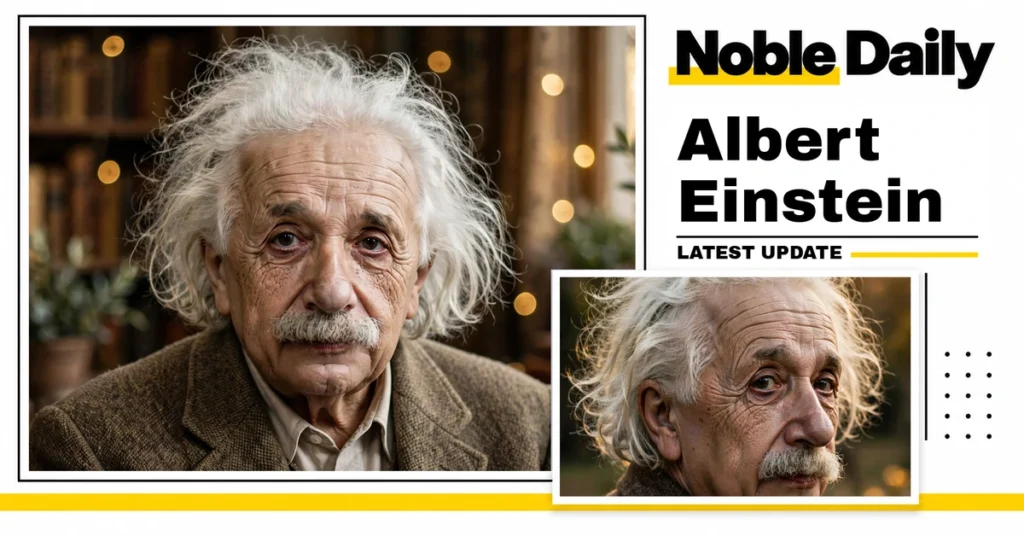
Albert Einstein was a German-born theoretical physicist whose work reshaped modern science. Best known for the theories of relativity and the equation E=mc², he also explained the photoelectric effect and the motion of particles in liquids.
His discoveries, public advocacy, and flight from Nazi Germany made him one of the most recognized figures of the 20th century.
Who Is Albert Einstein?
Albert Einstein was a theoretical physicist who changed how scientists understand space, time, gravity, light, and energy. Born in Germany in 1879, he became a Swiss citizen in 1901 and later settled in the United States, where he worked at the Institute for Advanced Study in Princeton.
| Full name | Albert Einstein |
| Born | March 14, 1879, in Ulm, Württemberg, German Empire |
| Died | April 18, 1955, in Princeton, New Jersey, United States |
| Age at death | 76 years old |
| Profession | Theoretical physicist |
| Education | Swiss Federal Polytechnic in Zurich and University of Zurich |
| Citizenship | Swiss and American. He renounced German citizenship in 1933. |
| Known for | Special and general relativity, the photoelectric effect, and E=mc² |
| Nobel Prize | Physics prize for 1921, received in 1922 |
| Parents | Hermann Einstein and Pauline Koch Einstein |
| Sister | Maria, known as Maja |
| Spouses | Mileva Marić and Elsa Einstein |
| Children | Lieserl, Hans Albert, and Eduard |
| Height in records | 171.5 to 175 centimeters, depending on the document |
| Cause of death | Ruptured abdominal aortic aneurysm |
Early Life and Family Background
Albert Einstein was born on March 14, 1879, in Ulm, in the Kingdom of Württemberg, then part of the German Empire. His parents were Hermann Einstein, a businessman in electrical engineering, and Pauline Koch Einstein. His younger sister, Maria, known as Maja, remained close to him throughout their lives.
The family moved to Munich when Albert was young. He enjoyed puzzles and building complex structures, and a geometry book fascinated him at about age twelve.
Popular stories often portray him as a poor student, but records show strong performance in mathematics and science. He disliked strict teaching methods and preferred understanding ideas over memorizing them.
Albert Einstein’s Education and Patent Office Career
Einstein studied mathematics and physics at the Swiss Federal Polytechnic in Zurich, now ETH Zurich, from 1896 to 1900. He earned a teaching diploma, but struggled to find a university job. In 1902, he became a technical expert at the Swiss Patent Office in Bern, reviewing patent applications involving electrical devices.
The job provided steady work and time to think about physics. He discussed ideas with friends in an informal group later nicknamed the Olympia Academy. Einstein submitted his doctoral research on molecular dimensions in 1905 and received his doctorate from the University of Zurich in 1906.
Why 1905 Is Called Einstein’s Miracle Year
The year 1905 is called Einstein’s “miracle year” because he published several papers that transformed physics while he still worked at the patent office.
His four major contributions from that period were:
- The photoelectric effect paper, which explained how light transfers energy in packets now called photons.
- A study of Brownian motion, which helped provide evidence for the existence of atoms and molecules.
- The special theory of relativity, which changed scientific ideas about space and time.
- A paper on mass and energy that introduced the relationship expressed as E=mc².
Together, these papers showed his ability to connect mathematics with basic questions about the physical world.
How Einstein’s Theory of Relativity Changed Physics
Einstein’s special theory of relativity, published in 1905, showed that measurements of time and space depend on an observer’s motion, while the speed of light in a vacuum remains constant. It also led to mass-energy equivalence, expressed as E=mc².
The equation means mass and energy are related, and a small amount of mass corresponds to a large amount of energy.
In 1915, Einstein completed the general theory of relativity, which describes gravity as the effect of mass and energy curving spacetime. Observations during a solar eclipse in 1919 supported its prediction that gravity bends starlight, bringing him worldwide fame.
Relativity later became important to technologies such as satellite navigation, which must account for differences in clock rates.
Why Einstein Won the Nobel Prize
Einstein received the 1921 Nobel Prize in Physics for explaining the law of the photoelectric effect, not specifically for relativity. The prize was presented in 1922 after the committee delayed its decision for the 1921 award year.
The photoelectric effect occurs when light causes a material to release electrons. Einstein argued that light transfers energy in discrete packets, an idea that helped shape quantum theory. The effect later became important to technologies such as light sensors and solar cells.
Who Was Einstein’s Wife and How Many Children Did He Have
Einstein married Mileva Marić, a fellow physics student, in January 1903. They had three children known from their correspondence: Lieserl, born in 1902, and sons Hans Albert, born in 1904, and Eduard, born in 1910.
The surviving record of Lieserl’s later life is incomplete, so her fate remains uncertain. Albert and Mileva divorced in February 1919.
In June 1919, Einstein married his cousin Elsa Löwenthal, née Einstein. Elsa had two daughters, Ilse and Margot, from an earlier marriage, and Einstein helped raise them.
She supported him through years of illness and public attention before her death in 1936. Einstein’s scientific fame did not remove the strains of long separations and demanding work.
What Was Einstein’s IQ, Height, and Net Worth
Einstein’s exact IQ is unknown because no verified standardized IQ score for him has been documented. The often repeated figure of 160 is an estimate, not a measured result. His scientific record shows exceptional ability without needing an invented number.
Historical records also give different heights. A Swiss service document listed him at 171.5 centimeters, while a 1923 passport listed 175 centimeters, or roughly 5 feet 7.5 inches to 5 feet 9 inches. No dependable, audited figure establishes Einstein’s net worth at death or a modern personal net worth total.
Online estimates often mix historical assets with later licensing revenue from his name and image.
Did Albert Einstein Invent Anything
Einstein was not mainly a consumer-product inventor, but he did co-develop patented devices. His best-known invention work was with physicist Leó Szilárd on a refrigerator system designed to prevent dangerous refrigerant leaks. They received a United States patent in 1930, but the design never became a mass-market product.
Einstein also worked with partners on technical patents, including a gyroscopic compass and a hearing device. His lasting fame, however, comes from his scientific ideas rather than a list of famous inventions.
Why Einstein Left Germany and Moved to America
Einstein left Germany after Adolf Hitler and the Nazi Party came to power in 1933. As a Jewish public figure who opposed nationalism and militarism, he faced a threat under the new regime.
He renounced German citizenship and moved to the United States, accepting a position at the Institute for Advanced Study in Princeton, New Jersey.
He became a United States citizen in 1940 while retaining Swiss citizenship. He spent the rest of his life in Princeton, working on theoretical physics and supporting refugees escaping persecution. He also spoke against racism and defended civil liberties.
In 1952, he declined an offer to become president of Israel, saying he lacked the experience needed for the role.
Did Einstein Work on the Manhattan Project
Einstein did not work on the Manhattan Project, the secret United States program that developed the first atomic bombs. His connection began with a letter dated August 2, 1939, which he signed and sent to President Franklin D. Roosevelt.
Drafted mainly by physicist Leó Szilárd, it warned that uranium research might make powerful weapons possible and urged the United States to take the danger seriously.
Roosevelt’s administration created a committee to study uranium, and later research contributed to the Manhattan Project. Einstein had no role in building the bomb. After the war, he spoke against nuclear arms and supported international cooperation. He later regretted signing the letter, which he believed had helped set a dangerous process in motion.
Einstein’s Religion and Views on Peace
Einstein was born into a Jewish family, and his Jewish identity became especially important as he confronted antisemitism and Nazi persecution. His personal religious views were complex. He did not believe in a personal God who intervenes in human affairs, but often described awe toward the order and beauty of nature.
He opposed militarism during World War I, supported international cooperation after World War II, and warned about nuclear weapons. In 1955, shortly before his death, he signed the Russell-Einstein Manifesto, which urged world leaders to recognize the danger of nuclear war and seek peaceful solutions.
How Einstein Died and What Happened to His Brain
Einstein died at Princeton Hospital on April 18, 1955, at age 76, after an abdominal aortic aneurysm ruptured. His body was cremated that day, and his ashes were scattered at an undisclosed location in keeping with his wishes. He has no public grave.
Pathologist Thomas Harvey removed Einstein’s brain during the autopsy for scientific study before obtaining the family’s permission. The family later approved the research. Scientists examined parts of the brain over several decades, but no single accepted finding explains Einstein’s genius. His legacy rests most securely on his published work.
What Were Einstein’s Last Words
Einstein’s exact last words are unknown. Accounts report that he spoke a few words in German shortly before he died, but the nurse who heard him did not understand German. Popular quotes presented as his final statement cannot be confirmed and should not be treated as fact.
Einstein’s Awards and Lasting Recognition
Einstein’s most important formal honor was the 1921 Nobel Prize in Physics, awarded for his explanation of the photoelectric effect and presented in 1922. In 1999, TIME magazine named him its Person of the Century, recognizing the influence of his ideas on modern science and society.
His name remains widely associated with scientific intelligence, although many popular stories about his IQ and school performance are inaccurate.
For more stories from this group of physicists, explore the biographies of Stephen Hawking, Isaac Newton, Michael Faraday, James Clerk Maxwell, Max Planck, Niels Bohr, Werner Heisenberg, Erwin Schrödinger, Paul Dirac, and Roger Penrose.
Conclusion
Albert Einstein’s legacy extends beyond one equation or theory. His research changed physics, while his experiences as a Jewish refugee and his later work for peace gave him a public role far beyond the laboratory. The lasting power of his ideas remains the clearest measure of his influence.