Frans de Waal
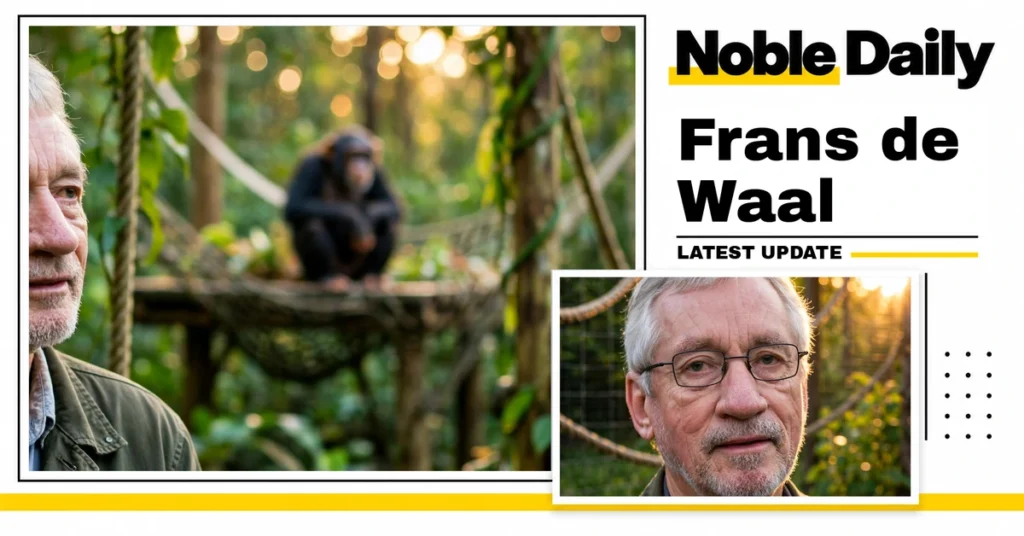
Frans de Waal was a Dutch-American primatologist whose research changed how people understand the minds and social lives of animals. Through decades of work with chimpanzees, bonobos, and monkeys, he explored empathy, cooperation, fairness, and conflict. His books and public talks brought these findings to readers around the world.
Who Is Frans de Waal?
Frans de Waal was a biologist, ethologist, professor, and bestselling author known for comparing primate behavior with human social life. He helped show that many behaviors once treated as uniquely human, including reconciliation and complex social cooperation, also appear in other primates.
| Full name | Frans B. M. de Waal |
| Born | October 29, 1948 |
| Birthplace | ’s-Hertogenbosch, the Netherlands |
| Nationality | Dutch-American |
| Profession | Primatologist, ethologist, professor, and author |
| Education | PhD in biology from Utrecht University, 1977 |
| Known for | Research on primate social behavior, empathy, fairness, and reconciliation |
| Academic home | Emory University and the Yerkes National Primate Research Center |
| Wife | Catherine Marin |
| Died | March 14, 2024, in Stone Mountain, Georgia |
| Age at death | 75 |
| Cause of death | Stomach cancer |
| Final published book | Minds I’ve Met, published posthumously in 2026 |
When Was Frans de Waal Born, and How Old Was He at Death?
Frans de Waal was born on October 29, 1948, and died on March 14, 2024, at age 75. He was born in ’s-Hertogenbosch in the Netherlands and died at his home in Stone Mountain, Georgia. Because he died before his 76th birthday, his correct age at death was 75.
What Was Frans de Waal’s Childhood Like?
De Waal’s interest in animals began in childhood, when he spent long hours outdoors observing nature. He grew up in Waalwijk in the southern Dutch province of Brabant and explored nearby ditches with a fishnet. His curiosity extended beyond primates to birds, fish, elephants, dolphins, and other animals.
Where Did Frans de Waal Study?
De Waal trained in zoology and ethology at Dutch universities, including Nijmegen, Groningen, and Utrecht. He earned a PhD in biology from Utrecht University in 1977 under primatologist Jan van Hooff. His early academic work examined macaques before he moved into close observation of chimpanzees.
How Did Arnhem Zoo Shape His Research?
His work with chimpanzees at Burgers’ Zoo in Arnhem helped establish his interest in the social rules that shape primate groups. He observed that chimpanzees often approached each other after fights, touched, embraced, and resumed contact. He described this behavior as reconciliation, helping bring the study of post-conflict repair into mainstream primate research.
What Did Frans de Waal Do at Emory and Yerkes?
After joining the Wisconsin National Primate Research Center in 1981, de Waal moved to Emory University in 1991. He became the C. H. Candler Professor of Primate Behavior and directed the Living Links Center at the Yerkes National Primate Research Center.
He retired from his full-time academic roles in 2019 but remained an influential voice in animal behavior research.
At Emory, his research included chimpanzees, bonobos, and capuchin monkeys. He also mentored students and early-career scientists, helping shape a new generation of researchers studying animal cognition and cooperation.
Which Books Made Frans de Waal Famous?
De Waal reached a broad audience by explaining scientific research through clear stories about individual animals and their social lives. His books connected field observations with larger questions about human nature, morality, and the evolution of behavior.
- Chimpanzee Politics (1982) explored alliances, competition, and leadership within a chimpanzee group.
- Peacemaking Among Primates (1989) examined how primates manage conflict and restore social bonds.
- Our Inner Ape (2005) used chimpanzees and bonobos to discuss human behavior.
- Are We Smart Enough to Know How Smart Animals Are? (2016) challenged narrow ideas about animal intelligence.
- Mama’s Last Hug (2019), Different (2022), and the posthumously published Minds I’ve Met (2026) explored animal emotions, gender, and the changing science of animal minds.
Minds I’ve Met: From Denying to Embracing the Inner Lives of Animals was published after his death in 2026. It revisits decades of research and the shift away from viewing animals as creatures driven only by instinct.
What Did He Discover About Chimpanzee Politics and Peacemaking?
De Waal showed that chimpanzee groups have shifting alliances, social ranks, rivalries, and ways to repair relationships. His observations suggested that conflict is only one part of group life because animals also use contact and social bonds to reduce tension.
These findings helped scientists study social behavior as more than a simple contest for food or dominance.
His first major book, Chimpanzee Politics, compared the power struggles he observed with political behavior among humans. The comparison was not that chimpanzees follow human institutions, but that both species can form alliances and respond strategically to changing relationships.
What Did Frans de Waal Teach Us About Empathy and Animal Emotions?
De Waal argued that emotions such as comfort, grief, and empathy should be studied in animals rather than assumed to belong only to humans. His work examined how primates respond to distressed group members, console one another, and react to familiar individuals.
He did not claim that every animal emotion is identical to a human feeling, but he argued that shared evolutionary history makes comparison important.
The story of Mama, an elderly chimpanzee at the Royal Burgers’ Zoo, became central to his book Mama’s Last Hug. In 2016, Mama embraced her longtime human friend, biologist Jan van Hooff, during his visit near the end of her life.
The widely viewed farewell helped introduce many readers to de Waal’s work on animal emotions.
Why Is His Capuchin Monkey Fairness Experiment Famous?
De Waal’s capuchin monkey experiments became famous because they showed how monkeys respond when they receive unequal rewards for the same task. In a well-known demonstration, one monkey received cucumber while a nearby monkey received a grape for handing over a small stone.
The monkey given cucumber sometimes rejected the food or showed visible frustration after seeing the better reward.
De Waal interpreted these reactions as evidence that monkeys are sensitive to unequal outcomes. The experiments helped fuel discussion about the evolutionary roots of fairness, although they do not prove that monkeys understand justice in exactly the same way humans do.
What Did Frans de Waal Learn From Bonobos?
De Waal studied bonobos to show that primate social life cannot be understood through aggression and competition alone. Bonobos often form strong social bonds and use affiliative behavior to ease tension, offering a useful comparison with chimpanzee groups. He used these differences to question claims that human nature is naturally selfish or violent.
His book Our Inner Ape brought chimpanzees and bonobos into a wider discussion of human behavior. He argued that humans have the potential for aggression and competition as well as care, cooperation, and social support.
What Did He Write About Morality and Religion?
In The Bonobo and the Atheist, de Waal explored how morality might grow from the social lives and evolutionary history of humans and other primates. He challenged the idea that moral behavior must be explained only as a rule imposed from outside, and examined the roles of empathy, cooperation, and social responsibility.
The book discusses religion and humanism, but its title alone should not be treated as proof of his personal religious identity.
What Did Frans de Waal Discuss in His TED Talks?
De Waal brought his research to a large public audience through talks about animal morality and the social costs of power. His 2011 TEDxPeachtree talk, “Moral Behavior in Animals,” used examples of fairness, reciprocity, empathy, and cooperation.
A later TED talk explored the surprising science of alpha males and the ways leadership can involve generosity and peacekeeping, not just force.
Who Was Frans de Waal’s Wife, and What Is Known About His Family?
Frans de Waal was married to Catherine Marin, who was described in a 2026 review of his final book as his wife of 54 years. She contributed an afterword to Minds I’ve Met, offering a personal perspective on his life and work.
Reliable public biographies provide limited consistent detail about children, so claims about that part of his family life should not be treated as confirmed without a strong source.
What Awards and Honors Did Frans de Waal Receive?
De Waal received recognition from major scientific organizations and was widely honored for making animal behavior research accessible to the public. His notable distinctions included election to the U.S. National Academy of Sciences and recognition by Time magazine.
- Elected to the U.S. National Academy of Sciences in 2004.
- Named one of Time magazine’s 100 Most Influential People in 2007.
- Elected to the American Academy of Arts and Sciences in 2008.
- Included among Discover magazine’s Great Minds of Science in 2011.
- Mama’s Last Hug received the PEN / E. O. Wilson Literary Science Writing Award.
What Was Frans de Waal’s Cause of Death?
Frans de Waal died from stomach cancer on March 14, 2024, at his home in Stone Mountain, Georgia. He was 75 years old and had retired from his academic roles several years earlier. His death was widely noted by universities, scientific societies, and fellow researchers who recognized his impact on primatology.
Frans de Waal’s research is often discussed alongside the other pioneering primatologists whose stories are covered here: Jane Goodall, Dian Fossey, Biruté Galdikas, and Robert Sapolsky.
Conclusion
Frans de Waal changed the study of animal behavior by taking the social lives of primates seriously and showing how much they could reveal about humans. His research on fairness, empathy, and cooperation challenged simple claims about human uniqueness while keeping scientific evidence at the center.
Through his books, teaching, and public talks, he left a lasting influence on how people think about animals and our place in the natural world.