Max Planck Biography | Quantum Theory, Life & Legacy
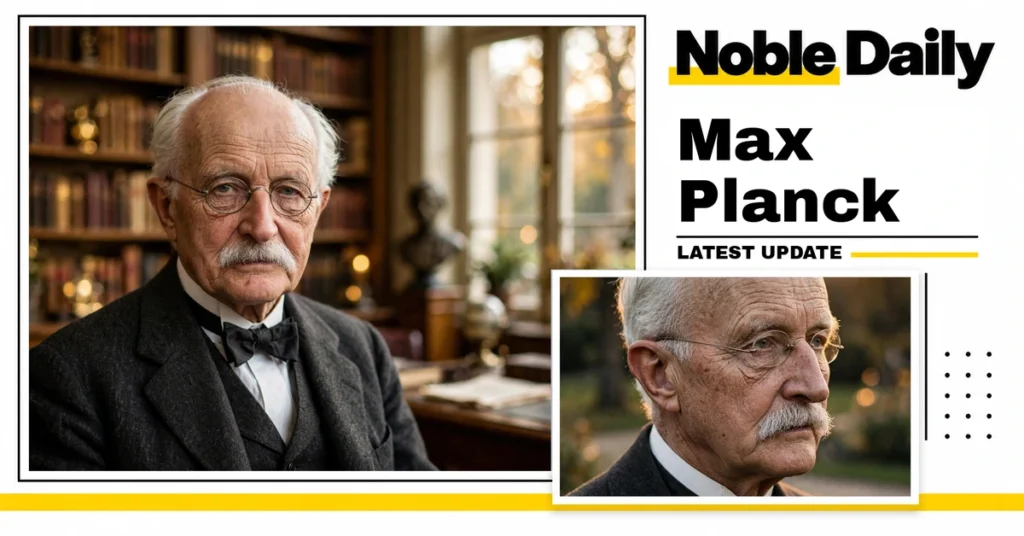
Max Planck was a German theoretical physicist whose work on blackbody radiation helped launch modern quantum theory. Born on April 23, 1858, he developed a new way to describe how energy is exchanged at the atomic scale. His discovery earned him the 1918 Nobel Prize in Physics and changed the direction of science.
Who Is Max Planck?
Max Planck was a leading German physicist best known for proposing that energy exchanges could occur in discrete units, an idea that became a foundation of quantum physics. His research joined mathematics with thermodynamics and helped explain how heated objects emit light.
| Full name | Max Karl Ernst Ludwig Planck |
| Born | April 23, 1858, in Kiel, now Germany |
| Died | October 4, 1947, in Göttingen, Germany |
| Age at death | 89 years old |
| Nationality | German |
| Field | Theoretical physics and thermodynamics |
| Known for | Quantum hypothesis, blackbody radiation law, and Planck’s constant |
| Nobel Prize | 1918 Nobel Prize in Physics, received in 1919 |
| Spouses | Marie Merck and Marga von Hoesslin |
| Children | Karl, Erwin, Emma, Grete, and Hermann |
| Burial | Stadtfriedhof Göttingen, Germany |
Early Life and Education in Munich and Berlin
Max Planck grew up in an academic family and became interested in physics while attending school in Munich. His father, Julius Wilhelm Planck, was a law professor, while earlier generations of the family included scholars of theology. The family valued learning, discipline, and public service.
Planck was also a gifted musician. He played the piano and organ well and considered several possible paths before choosing physics. He entered the University of Munich in 1874, then studied in Berlin, where lectures by leading scientists and his own reading in thermodynamics helped shape his interests.
In 1879, at age 21, Planck earned his doctorate with a dissertation on the second law of thermodynamics. He completed his postdoctoral qualification in 1880 and began teaching at Munich. His early work focused on heat, entropy, and the rules that govern energy, subjects that later became central to his most famous discovery.
How Max Planck Changed Physics With Quantum Theory
Planck helped launch quantum theory in 1900 by finding a formula that correctly described the spectrum of radiation emitted by a heated object. Scientists had measured this radiation carefully, but classical physics could not explain its full pattern. Existing calculations failed badly at high frequencies.
Planck studied the problem by linking the distribution of radiation to the energy of tiny vibrating systems. His result worked when energy exchanges were treated as discrete units rather than as quantities that could vary without limit.
The key relationship is commonly written as E = hν, meaning energy is linked to frequency through a constant now known as Planck’s constant.
The idea was revolutionary, although Planck did not immediately embrace every implication that later physicists found in it. His original model focused on energy exchanges in oscillators. In 1905, Albert Einstein took the quantum idea further by proposing that light itself could behave as packets of energy, helping explain the photoelectric effect.
Other scientists later built quantum mechanics into a broader theory of atoms and subatomic particles.
What Is Planck’s Constant and Why Does It Matter?
Planck’s constant connects the energy of a quantum with the frequency of the radiation involved. Its symbol is h, and its exact value in the modern International System of Units is 6.62607015 × 10⁻³⁴ joule seconds. The value is now fixed by the definition of the SI units, including the kilogram.
The constant is not just a historical label. It sets the scale at which quantum effects matter and appears throughout quantum physics. Planck’s contribution was theoretical rather than a mechanical invention, but the constant that bears his name remains part of the basic language of modern science.
What Planck’s Law Explains About Blackbody Radiation
Planck’s law describes how the intensity of radiation from an ideal blackbody changes with wavelength or frequency at a given temperature. A blackbody absorbs incoming radiation and emits a spectrum determined by its temperature, not by the material from which it is made.
The law helped explain familiar changes in the color of hot objects. As an object heats up, its glow can shift from red toward white as the distribution of emitted light changes.
The law also gave scientists a precise way to test theories about heat and light, making it a major bridge between laboratory measurements and new physical ideas.
Why Max Planck Won the Nobel Prize
Planck received the 1918 Nobel Prize in Physics for his discovery of energy quanta and its contribution to physics. The prize was assigned for 1918, but he received it the following year, in 1919.
The recognition came after years of work on a difficult theoretical problem. Planck’s radiation formula fit the experimental evidence, and the quantum idea behind it opened a path that other physicists developed into modern quantum mechanics.
His honors also included the Copley Medal from the Royal Society in 1929 and the Max Planck Medal, which was established in 1929 and first awarded to Planck and Albert Einstein.
Max Planck and Albert Einstein
Max Planck and Albert Einstein were two central figures in the early development of modern physics, but their roles were different. Planck introduced the quantum hypothesis while studying thermal radiation. Einstein later used quantum ideas to explain the photoelectric effect and made major contributions to relativity.
Planck recognized the importance of Einstein’s work and helped make room for new theoretical ideas within German physics. The two men also shared an interest in music, and Planck hosted gatherings where scientists and musicians played together. Their connection shows how scientific change often grows through both debate and professional support.
Family Life and Personal Interests
Planck married Marie Merck in 1887, and they had four children: Karl, Erwin, and twin daughters Emma and Grete. Marie died in 1909. Planck married Marga von Hoesslin, his first wife’s niece, in 1911, and they had another son, Hermann.
His family life was marked by repeated loss. Karl was killed during the First World War in 1916, and both daughters died after childbirth, Grete in 1917 and Emma in 1919. Erwin was executed by the Nazi regime in January 1945. Hermann, Planck’s youngest child, died in 1954, after his father.
Outside the laboratory, Planck loved music, walking, and mountain hiking. He often played music with friends and colleagues, including Einstein. He also enjoyed hiking in the Alps and remained active outdoors well into old age, a personal interest that offered a contrast to the discipline of his academic life.
Max Planck During Nazi Germany and World War II
Planck faced painful choices after the Nazis came to power in 1933. As president of the Kaiser Wilhelm Society from 1930 to 1937, he tried to protect German research institutions and preserve some room for independent science. His approach involved compromises, and he could not stop the regime from taking control of scientific organizations.
At the same time, Planck spoke up for colleagues who were at risk and helped some Jewish scientists remain employed for a time. He supported a 1935 memorial event for physicist Fritz Haber, who had been forced out of Germany.
In 1938, Planck resigned from the Prussian Academy of Sciences in protest against its forced political alignment.
The war brought personal and professional destruction. An air raid destroyed his Berlin home in 1944, including scientific papers and possessions.
His son Erwin Planck was arrested because of his links to the opposition involved in the July 20, 1944, attempt to kill Adolf Hitler and was executed on January 23, 1945. Planck’s appeals could not save him.
When Max Planck Died and Where He Is Buried
Max Planck died in Göttingen on October 4, 1947, at the age of 89. After the war, he had helped with efforts to reorganize German scientific research and served briefly as acting president of the Kaiser Wilhelm Society.
Some biographical accounts connect his death to the effects of a fall and several strokes, while many institutional summaries record the date and place without giving a detailed medical cause.
Planck is buried at Stadtfriedhof Göttingen. His grave is a quiet memorial to a scientist whose ideas transformed physics. The formula for his quantum of action is engraved on the gravestone, linking the place of his burial to the discovery that made him famous.
How Max Planck Is Remembered Today
Max Planck is remembered as one of the founders of quantum physics and as a major figure in German scientific life. His legacy is visible in the constant named for him, in the law of blackbody radiation, and in the scientific methods that grew from his work.
The Max Planck Society was founded in 1948 as the successor to the Kaiser Wilhelm Society and took its name from the physicist. It supports research institutes across a wide range of fields.
Although Planck died before the society was formally established, his international reputation helped make his name a symbol of scientific research and intellectual independence.
His story is also more complex than a single breakthrough. Planck’s career included scientific achievement, a commitment to preserving research institutions, difficult compromises under dictatorship, and profound family loss. Remembering all of these parts gives a fuller picture of the person behind a fundamental idea in modern physics.
After Max Planck, you may also enjoy the biographies of Stephen Hawking, Albert Einstein, Isaac Newton, Michael Faraday, James Clerk Maxwell, Niels Bohr, Werner Heisenberg, Erwin Schrödinger, Paul Dirac, and Roger Penrose.
Conclusion
Max Planck changed science by showing that energy could be exchanged in discrete units, opening the door to quantum theory.
His work on blackbody radiation and Planck’s constant helped shape modern physics, while his long career carried him through war, political pressure, and personal tragedy. His scientific legacy continues in research and in the institutions that bear his name.