Michael Faraday Biography | Life, Discoveries and Legacy
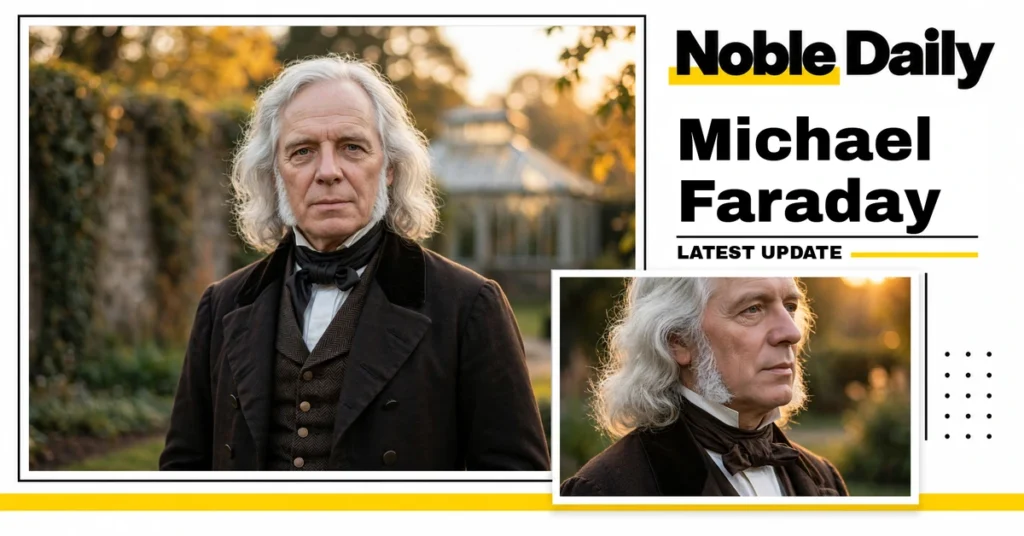
Michael Faraday was a British physicist and chemist whose experiments changed how people understood electricity and magnetism. Born into a family with limited means, he had little formal education but became one of the leading scientists of the nineteenth century. His discoveries helped shape electric motors, generators, transformers, and modern physics.
Who Is Michael Faraday?
Michael Faraday was an experimental scientist best known for discovering electromagnetic induction and advancing the study of electrochemistry.
He spent much of his career at the Royal Institution in London, where he tested ideas through careful experiments and shared his findings with the public.
His work connected electricity, magnetism, light, and chemistry in ways that later scientists could build upon.
Faraday’s story is remarkable because he did not enter science through a university or an elite family network. He learned by reading, observing, asking questions, and practicing in the laboratory. His career shows how strong experimental skills can lead to discoveries that change everyday life.
These key details provide a quick overview of Faraday’s life, family, career, and major contributions.
| Full name | Michael Faraday |
| Born | September 22, 1791 |
| Birthplace | Newington Butts, Surrey, England, now part of London |
| Died | August 25, 1867 |
| Age at death | 75 years old |
| Nationality | British |
| Fields | Physics and chemistry |
| Wife | Sarah Barnard, married in 1821 |
| Children | No children |
| Known for | Electromagnetic induction, electrochemistry, benzene, and electrical shielding |
| Main institution | Royal Institution of Great Britain |
| Famous publication | The Chemical History of a Candle, published in 1861 |
Early Life and Education
Faraday was born on September 22, 1791, in Newington Butts, an area now within London. His father, James Faraday, worked as a blacksmith, and his mother, Margaret, helped raise the family during difficult financial times. The family belonged to the Sandemanian Christian community, which later became important to Faraday’s own life.
A Bookbinding Apprenticeship Opened a Door
At about fourteen, Faraday began an apprenticeship with George Riebau, a London bookbinder and bookseller. The job gave him access to books on many subjects. While preparing books for customers, he read about science, including electricity and chemistry. He became especially interested in how experiments could explain the natural world.
Faraday also joined gatherings at the City Philosophical Society, where people discussed scientific ideas. These experiences helped him learn beyond the limited schooling available to him. Instead of treating his lack of formal education as a final barrier, he used every chance to study and practice.
Science Learned Outside the Classroom
Faraday read Jane Marcet’s Conversations on Chemistry and scientific articles in the Encyclopedia Britannica. He also made notes, tried basic experiments, and learned to describe what he observed. This habit of careful record keeping became one of his strengths as a researcher.
A customer of the bookshop gave him tickets to lectures by the chemist Humphry Davy at the Royal Institution. Faraday attended, took detailed notes, and sent Davy a bound collection of them. That effort helped him move from an apprenticeship into a professional scientific career.
How Michael Faraday Joined the Royal Institution
In 1813, Faraday was hired as a chemical assistant at the Royal Institution. The appointment gave him access to laboratory equipment, scientific discussions, and a community of researchers. He learned by carrying out experiments, preparing materials, and working closely with experienced scientists.
Working With Humphry Davy
Faraday worked under Humphry Davy, one of Britain’s best known chemists. Later in 1813, he travelled through Europe with Davy and Davy’s wife. The trip introduced him to scientific institutions and researchers in other countries, although his role also included personal service duties for the Davy household.
After returning to England in 1815, Faraday continued laboratory work and developed his skills in practical and analytical chemistry. His rise was gradual. He earned greater responsibility through reliable experiments, careful notes, and a growing ability to solve difficult research problems.
From Assistant to Research Leader
Faraday became director of the Royal Institution’s laboratory in 1825. In 1833, a special research chair, the Fullerian Professorship of Chemistry, was created for him. He also served as a scientific adviser to the Admiralty and later advised Trinity House, the organization responsible for many British lighthouses and navigation aids.
These roles show that Faraday’s work was not limited to theory. His practical knowledge was useful for public institutions, maritime safety, and the growing technologies of his time. In 1824, he was elected a Fellow of the Royal Society, one of Britain’s leading scientific bodies.
Michael Faraday’s Most Important Discoveries
Faraday’s most influential research explored the relationship between electricity and magnetism. His experiments helped turn these forces from separate subjects into parts of a connected scientific picture. He often used simple apparatus and clear demonstrations to reveal effects that other researchers could repeat and test.
Electromagnetic Rotation and the Early Electric Motor
In 1821, Faraday demonstrated electromagnetic rotation. His apparatus showed that an electric current and a magnet could create continuous motion. This was an important early step toward the electric motor, a device that changes electrical energy into movement. Motors later became central to factory machinery, household appliances, and transport.
Faraday’s experiment was not a modern motor ready for commercial use. Its importance was that it demonstrated a basic principle. Electrical and magnetic forces could work together to produce motion, giving later inventors a foundation for practical designs.
Electromagnetic Induction and Electric Generators
In 1831, Faraday discovered electromagnetic induction. He showed that a changing magnetic field could produce an electric current in a conductor. In one experiment, he wound coils around an iron ring and found that a change in current in one coil affected the other. The device demonstrated the principle behind a transformer.
In another experiment, Faraday rotated a copper disc between the poles of a magnet and produced a steady current. This was an early form of electric generator. Generators today use the same broad principle to convert movement into electrical energy, while transformers use induction to change voltage in power systems.
Faraday’s experiments did not create the modern electrical grid by themselves. They supplied key scientific principles that engineers later developed into useful equipment for generating and distributing electricity.
The Faraday Cage and Magnetic Lines of Force
Faraday investigated how electric charge behaved around conductive materials. In 1836, he demonstrated that a conducting enclosure could protect its interior from external electrostatic effects. This principle is now known as the Faraday cage and is used in different forms to shield sensitive equipment from electrical interference.
He also used iron filings and other demonstrations to show patterns around magnets. Faraday described these patterns as lines of force and developed the idea that forces could be represented through fields in space. His field concept was important to later physics, especially the mathematical work of James Clerk Maxwell.
Light, Magnetism, and Diamagnetism
In 1845, Faraday discovered that a magnetic field could affect the polarization of light passing through certain materials. This finding, known as the Faraday effect, showed a link between magnetism and light. In the same period, he investigated diamagnetism, a property in which some materials respond to a magnetic field in a distinctive way.
Faraday did not express his field ideas through advanced mathematics, but his physical picture gave later scientists a way to think about how electromagnetic forces spread through space. Maxwell later translated key parts of this picture into mathematical equations that became central to classical electromagnetism.
Faraday’s Contributions to Chemistry
Faraday was also a skilled chemist. He studied gases, hydrocarbons, alloys, optical glass, and the chemical effects of electric current. His chemistry research helped strengthen his reputation long before his discoveries in electromagnetic induction became widely recognized.
Benzene and the Liquefaction of Gases
In 1825, Faraday identified a compound that later became known as benzene. He found it while investigating substances obtained from illuminating oil. Benzene became an important compound in organic chemistry and industrial production, although it is now known to be hazardous and requires careful handling.
Faraday also helped demonstrate that gases such as chlorine could be liquefied under suitable conditions. His work on gases expanded scientific knowledge of how substances behave under pressure and temperature changes. He also studied optical glass and steel alloys, though not every research project led to a successful result.
The Laws of Electrolysis
Faraday studied how an electric current causes chemical change in a solution. His research led to two laws of electrolysis, which relate the amount of chemical change to the quantity of electricity that passes through a system. These laws helped make electrochemistry more exact and measurable.
With the scholar William Whewell, Faraday also helped develop terms for describing electrochemical processes. Words such as electrode, cathode, anode, and ion became part of the language of science. The unit of electrical capacitance, the farad, was later named in his honor.
Teaching Science to the Public
Faraday believed that scientific knowledge should be shared beyond specialist laboratories. He became a gifted lecturer who used demonstrations to make difficult ideas easier to understand. His public work helped people see science as something they could observe, question, and learn rather than a subject reserved for experts.
The Royal Institution Christmas Lectures
Faraday gave his first Royal Institution Christmas Lecture in 1827 and went on to present 19 series, more than any other individual in the lecture series’ history. His talks covered topics such as chemistry, electricity, and the forces of nature. He also helped make the institution’s public science events a lasting tradition.
The lectures were designed to engage young audiences through clear explanations and visible experiments. Faraday prepared them with the same care he brought to laboratory work, making sure the demonstrations supported the main idea rather than serving only as entertainment.
The Chemical History of a Candle
One of Faraday’s best known lecture series explored the science of a burning candle. He used an ordinary object to explain combustion, gases, water, and the chemical changes involved in a flame. The lectures were published as The Chemical History of a Candle in 1861 and remain a classic example of science communication.
The candle lectures captured Faraday’s approach to teaching. He encouraged audiences to look closely at everyday events and ask what they could reveal about nature. That approach still works well in science education today.
Wife, Family, Faith, and Personal Life
Faraday’s public career was matched by a private life shaped by family, faith, and personal discipline. Although he became internationally respected, he avoided the pursuit of social status and preferred to focus on research, teaching, and his religious community.
Marriage to Sarah Barnard
Faraday married Sarah Barnard in 1821. She belonged to the Sandemanian community, which was central to their shared life. The couple had no children, and Sarah remained his partner throughout his long scientific career. She outlived him, dying in 1879.
Religious Beliefs and Personal Values
Faraday was a committed member of the Sandemanian Christian church. His faith influenced his values, but he approached scientific questions through observation and experiment. Accounts of his career often emphasize his modesty, patience, and refusal to let honors become the main purpose of his work.
Faraday declined the presidency of the Royal Society when it was offered to him on two occasions. It is sometimes said that he refused a knighthood, but the Royal Institution notes that there is no evidence he was ever formally offered one. This distinction helps separate a popular story from the documented record.
Final Years and Death
Faraday’s health affected his research at different points, including a serious period of illness in 1839. He later returned to important work on magnetism and light. As he grew older, he reduced some of his scientific duties, but his influence remained strong among researchers and the wider public.
In 1858, Queen Victoria provided Faraday with a home at Hampton Court. He died there on August 25, 1867, at the age of 75. He was buried in the Sandemanian plot at Highgate Cemetery in London. His death marked the end of a career that had helped reshape both chemistry and physics.
Why Michael Faraday Still Matters
Faraday’s discoveries remain part of the foundations of modern technology. Electric generators rely on electromagnetic induction, transformers use the same principle to adjust voltage, and electric motors depend on the relationship between current and magnetic fields. Electrical shielding also draws on the effects he demonstrated with conductive enclosures.
His legacy is not limited to devices. Faraday helped establish a way of thinking about fields that influenced modern physics. His experiments also show the value of curiosity, accurate observation, and clear communication. Without a university education, he became a major scientific figure by learning continuously and testing ideas carefully.
If Michael Faraday’s story caught your interest, keep reading with the biographies of Stephen Hawking, Albert Einstein, Isaac Newton, James Clerk Maxwell, Max Planck, Niels Bohr, Werner Heisenberg, Erwin Schrödinger, Paul Dirac, and Roger Penrose.
Conclusion
Michael Faraday changed science through experiments that connected electricity, magnetism, light, and chemistry. His discoveries helped make modern electrical technology possible, while his lectures brought science to a broad public. From a bookbinding apprentice to a leading scientist, Faraday showed how persistence, curiosity, and careful observation can leave a lasting mark on the world.